Cars With Advanced Safety Features at Different Price Points
>> Automobile>> Cars With Advanced Safety Features at Different Price Points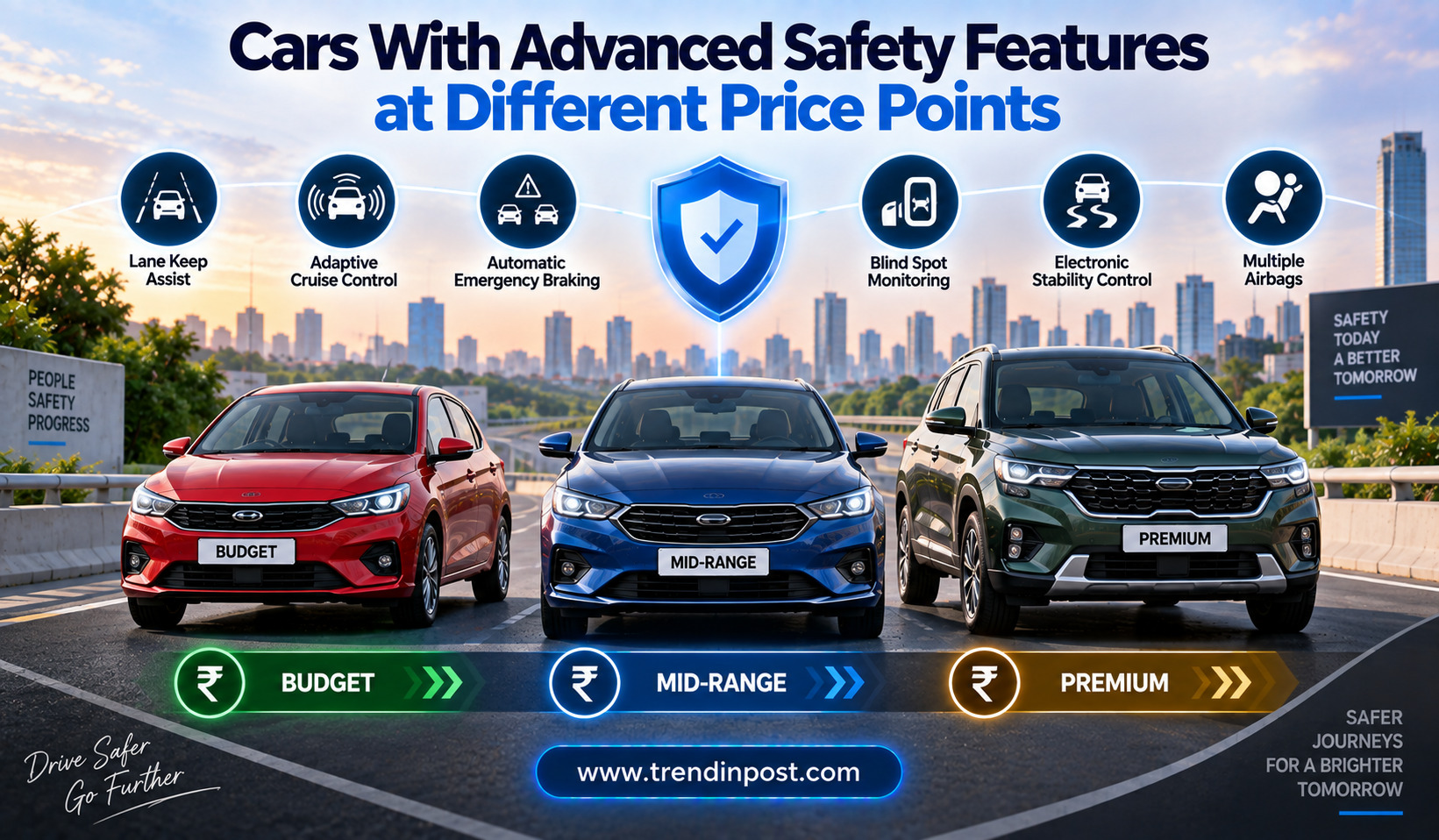
Cars With Advanced Safety Features at Different Price Points
Safety has become one of the most important factors influencing new-car buying decisions in India. Buyers are no longer looking only at engine performance, mileage, design and infotainment features. Airbags, electronic stability control, parking assistance, cameras and driver-assistance technologies are increasingly becoming part of the conversation when families compare cars.
Another major change is that safety equipment is no longer limited to expensive luxury vehicles. Features that were once associated mainly with premium cars are gradually appearing in more affordable segments. This has given buyers more choices, although the type and sophistication of safety equipment still vary considerably according to the vehicle and its price.
From entry-level hatchbacks to premium SUVs, manufacturers are taking different approaches to improving occupant protection and driver assistance. Understanding what buyers can realistically expect at different price points can make the purchasing process easier.
Safety Features Are Becoming More Accessible
The Indian car market has changed considerably over the last few years. Mandatory safety requirements have encouraged manufacturers to improve basic protection, while customer awareness has increased demand for additional safety equipment.
Features such as multiple airbags, ABS with EBD, electronic stability control, seat-belt reminders and rear parking sensors are now familiar to many buyers. Higher segments add technologies such as surround-view cameras, blind-spot monitoring, adaptive cruise control and autonomous emergency braking.
However, buyers should remember that a longer safety-feature list does not automatically make one vehicle safer than another. Crash structure, restraint systems, tyre quality, electronic stability systems and crash-test performance all contribute to overall safety.
Entry-Level Cars: Essential Safety Comes First
At the lower end of the market, buyers generally focus on obtaining essential safety equipment without pushing the purchase price too high. Modern entry-level cars can offer features that make everyday driving safer, particularly compared with older generations of budget vehicles.
Basic electronic safety systems are particularly useful because they can help drivers maintain control during emergency situations. ABS can reduce the chance of wheel lock under hard braking, while electronic stability control can help correct certain types of loss of control.
Rear parking sensors and rear cameras are also valuable in crowded urban environments. They may not be advanced driver-assistance technologies, but they can reduce the difficulty of manoeuvring in tight parking areas.
For buyers in this segment, the priority should be a strong combination of fundamental safety equipment rather than simply chasing the largest number of features.
Mid-Range Cars Add More Convenience and Protection
As buyers move into compact SUVs, premium hatchbacks and midsize cars, the safety package generally becomes more comprehensive. Manufacturers have greater scope to include additional sensors, cameras and electronic assistance systems.
Higher variants in this category may offer features such as a larger number of airbags, electronic stability control, hill-hold assistance, tyre-pressure monitoring and improved parking-camera systems. Some models also begin introducing advanced driver-assistance features.
This segment is particularly important because it represents a large portion of the Indian market. Buyers can often find a balance between price, practicality and safety without moving into luxury-car territory.
For a family car, features that assist during everyday driving can be especially useful. A good camera system can help with parking, while stability-control technology can provide additional assistance when road grip changes unexpectedly.
Premium Cars Bring Advanced Driver Assistance
At higher price points, the safety conversation moves beyond passive protection and basic electronic systems. Premium cars increasingly offer advanced driver-assistance systems, commonly referred to as ADAS.
These systems use cameras, radar or other sensors to monitor the road and assist the driver in specific situations. Depending on the vehicle, the package can include technologies such as adaptive cruise control, lane-keeping assistance, forward-collision warning and automatic emergency braking.
These features can reduce driver workload on highways and may help avoid or reduce the severity of certain collisions. However, they are designed as assistance systems rather than replacements for an attentive driver.
Drivers still need to monitor the road, understand system limitations and remain responsible for controlling the vehicle.
Safety Features at Different Price Points
| Approximate Segment | Safety Equipment Buyers May Find | Typical Focus |
| Entry-level | Airbags, ABS, EBD, rear parking sensors, seat-belt reminders | Basic occupant and braking safety |
| Mid-range | ESC, hill-hold, rear camera, TPMS, additional airbags | Everyday protection and control |
| Upper mid-range | 360-degree camera, additional electronic assistance, stronger safety packages | Greater driver support |
| Premium | ADAS, adaptive cruise control, lane assistance, collision warning | Advanced driver assistance |
| Luxury | Multiple ADAS functions, advanced parking systems, extensive sensor technology | Comprehensive driver assistance and premium safety |
Airbags Remain an Important Part of the Package
Airbags are among the most familiar safety features in a modern car, but their number and placement can vary significantly between models and variants. Front airbags provide essential protection in certain frontal collisions, while additional side and curtain airbags can provide protection in other types of impacts.
Buyers should therefore look beyond a simple statement that a car has airbags. It is useful to understand which airbags are offered and whether the equipment is standard across the range or restricted to higher variants.
At the same time, airbags work as part of a broader restraint system. Seat belts remain fundamental to occupant protection, and electronic systems such as stability control can help prevent some accidents from occurring in the first place.
Electronic Stability Control Is Increasingly Important
Electronic stability control has become one of the key safety technologies in modern vehicles. The system can detect situations where the vehicle is not following the driver’s intended direction and can intervene through braking and engine-control inputs.
This can be particularly useful during sudden manoeuvres or when traction changes between tyres. It does not guarantee that a car will avoid an accident, but it can provide an additional layer of assistance.
For buyers comparing cars at similar prices, the availability of electronic stability control should be taken seriously. It is one of the technologies that can contribute to maintaining vehicle control during difficult situations.
Parking Technology Makes Urban Driving Easier
Safety is not limited to high-speed crashes. Everyday low-speed situations can also lead to accidents, especially in crowded parking areas and narrow roads.
Rear cameras, parking sensors and 360-degree camera systems can help drivers understand the area around the vehicle. A surround-view system is particularly useful because it creates a broader view of the car’s immediate surroundings.
These features can be valuable for large SUVs, where the driver’s view around the vehicle may be more limited. However, cameras and sensors should always complement careful observation rather than replace it.
ADAS Is Changing the Premium-Car Experience
Advanced driver assistance is one of the biggest developments in modern automotive safety. Depending on the model, ADAS can provide warnings or assistance when the vehicle approaches another object too quickly, drifts from its lane or follows another vehicle too closely.
Adaptive cruise control can also adjust the vehicle’s speed according to traffic conditions. This can make long highway journeys less tiring, although the driver must continue monitoring the road.
The effectiveness of these systems depends on road markings, traffic conditions, weather and sensor performance. Indian roads can present complex situations involving motorcycles, pedestrians and unpredictable lane behaviour, so drivers should understand exactly how the system operates before relying on it.
Safety Ratings Still Matter
Safety equipment should not be evaluated independently of a vehicle’s crash performance. Independent crash-test programmes can provide useful information about how a particular vehicle performs under controlled impact conditions.
A car with numerous electronic features is not automatically safer than a vehicle with fewer features but strong structural performance. Buyers should consider both passive safety and active safety when comparing vehicles.
A sensible safety assessment should therefore look at:
- Standard safety equipment across variants.
- Crash-test results where available.
- Electronic stability and braking systems.
- Availability and performance of driver-assistance technologies.
This approach gives buyers a more complete picture than simply counting features.
Don’t Ignore Tyres and Brakes
Even the most sophisticated electronic safety systems cannot overcome poor vehicle maintenance. Tyres have a direct influence on braking, cornering and grip, making their condition extremely important.
Correct tyre pressure, adequate tread depth and suitable replacement tyres all contribute to everyday safety. Brakes, suspension components, lights and windscreen visibility also need regular attention.
This is particularly important for used-car buyers. A vehicle may have an impressive safety specification when new, but its real-world condition matters enormously several years later.
Which Price Point Offers the Best Safety Value?
There is no single answer because safety requirements vary between buyers. A family looking for an affordable city car may prioritise airbags, stability control, ABS and parking assistance. Someone who regularly travels on highways may place greater value on advanced driver-assistance systems.
The mid-range segment can offer an attractive balance for buyers who want comprehensive safety without paying luxury-car prices. Premium vehicles, meanwhile, can provide more advanced technology and a wider range of assistance systems.
The important point is to compare actual variants rather than assuming every version of a model receives the same equipment.
The Future of Car Safety
Car safety is likely to become even more technology-driven as manufacturers introduce improved sensors, cameras and software. Driver-assistance systems are expected to become more widespread across different vehicle segments.
At the same time, fundamental safety features will remain essential. Strong vehicle construction, effective restraint systems, reliable brakes and good tyres cannot be replaced by software.
For buyers, this means the definition of a safe car is becoming broader. Modern safety involves preventing accidents where possible, reducing injury risk during crashes and helping drivers manage difficult situations.
Final Thoughts
Cars with advanced safety features are now available across a much wider range of prices than they were in the past. Entry-level models can provide important fundamental protection, while mid-range cars increasingly combine these systems with additional electronic safety and parking technologies. Premium vehicles take the concept further with sophisticated ADAS features.
However, buyers should avoid judging safety purely by the number of features listed in a brochure. Crash performance, standard equipment, vehicle structure, tyres and braking systems all deserve attention.
The best approach is to compare the complete safety package offered by each vehicle and check which features are available in the specific variant being considered. With safety becoming an increasingly important part of the Indian car-buying decision, buyers now have more opportunities to find vehicles that combine affordability, practicality and modern protection.
FAQs
What are the most important safety features in a car?
ABS, electronic stability control, airbags, seat belts and a strong occupant-protection structure are among the key safety elements. Parking sensors and cameras can also improve everyday safety.
Are expensive cars always safer?
Not necessarily. Higher-priced cars often offer more advanced technology, but safety depends on the vehicle’s structural performance, standard equipment, restraint systems and driver-assistance capabilities.
What is ADAS in a car?
ADAS stands for Advanced Driver Assistance Systems. Depending on the vehicle, it can include features such as lane assistance, adaptive cruise control, forward-collision warning and automatic emergency braking.
Is a 360-degree camera a safety feature?
It can improve low-speed safety by giving the driver a better view around the vehicle while parking or manoeuvring. It should be used as an assistance tool rather than as a substitute for checking the surroundings.
Should I prioritise airbags or ADAS?
Both serve different purposes. Airbags are designed to help protect occupants during a collision, while ADAS can assist the driver and potentially help prevent or reduce the severity of some collisions.
Related Post
How Digital Instrument Clusters Changed Car Interiors
Car interiors have changed significantly over the past decade, and one of the most noticeable…