Electric Car Range: What Do Buyers Really Need?
>> Automobile>> Electric Car Range: What Do Buyers Really Need?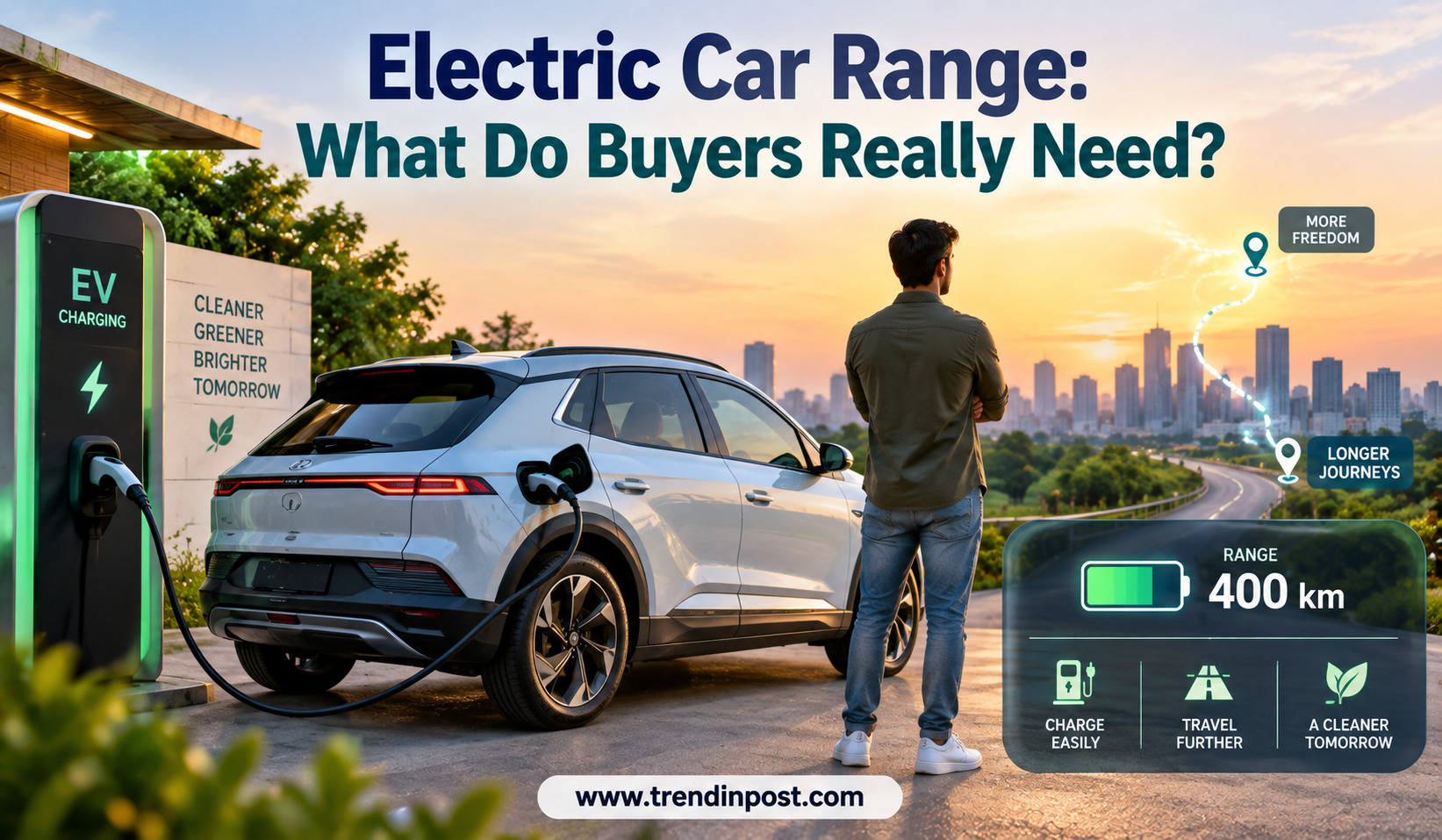
Electric Car Range: What Do Buyers Really Need?
Electric car range has become one of the biggest talking points for buyers considering an EV. Manufacturers often highlight impressive claimed range figures, while buyers naturally want to know how far the car can actually travel between charges. But does every electric car buyer really need the longest possible range?
The answer depends on how the vehicle will be used. Someone who drives a predictable distance to work every day may not need an EV with an extremely large battery. On the other hand, buyers who regularly travel between cities may benefit from additional range and access to a reliable fast-charging network.
As electric vehicles become available across more price segments in India, understanding range has become more important than simply comparing the biggest number in a specification sheet. Real-world driving conditions, charging habits, weather, traffic and driving speed can all influence how far an EV travels on a single charge.
What Does Electric Car Range Actually Mean?
Range refers to the distance an electric vehicle can travel using the energy stored in its battery. Manufacturers publish an official range figure based on a standard testing procedure. This number provides a useful basis for comparing vehicles, but it should not automatically be interpreted as the exact distance every driver will achieve.
Real-world range can be different because everyday driving is less controlled than laboratory testing. Frequent acceleration, high speeds, air-conditioning use, heavy traffic and road gradients can all influence energy consumption.
For this reason, buyers should think about range as a practical operating window rather than a fixed number. A vehicle advertised with a particular certified range may deliver a different figure depending on where and how it is driven.
Why Claimed Range and Real-World Range Can Differ
One of the most common concerns among EV buyers is the difference between claimed and actual range. This does not necessarily mean that the manufacturer’s figure is misleading. Standardised testing is designed to provide a common basis for comparing vehicles under defined conditions.
Real roads are considerably less predictable. A driver travelling at high speed on a highway will generally use energy differently from someone moving through slow city traffic. Similarly, a heavily loaded vehicle travelling uphill can consume more energy than a lightly loaded car on level roads.
Driving style can also have a noticeable effect. Smooth acceleration and appropriate use of regenerative braking can help improve efficiency, while aggressive acceleration and sustained high speeds can increase energy consumption.
How Much Range Does a Daily Commuter Really Need?
For most urban commuters, the required range may be lower than expected. If a person travels around 30 to 50 km each day, an EV with a practical range well above the daily requirement can provide enough flexibility without requiring the largest available battery.
The important question is not simply how many kilometres the car can travel on one charge. Buyers should consider how frequently they can charge it and where that charging takes place.
For example, a commuter who can charge at home every night may find a moderate-range EV more convenient than someone who has no dedicated charging facility. In the first situation, the vehicle can start most mornings with a high state of charge.
This makes charging access just as important as the headline range figure.
City Driving Can Be Different From Highway Driving
Electric cars can be particularly efficient in urban conditions because electric motors can deliver power directly and regenerative braking can recover some energy during deceleration.
However, highway driving introduces different challenges. Sustained high speeds generally require more energy, which can reduce the distance available from a full battery compared with slower urban driving.
This is important for buyers who regularly travel between cities. An EV that works comfortably for weekday commuting may require more careful planning for weekend highway journeys.
The right amount of range should therefore be based on the owner’s entire driving pattern rather than only the distance between home and the workplace.
Battery Size Is Not the Only Factor
A larger battery generally provides greater potential range, but it also adds weight and can increase the vehicle’s cost. Manufacturers therefore have to balance battery capacity, efficiency, performance and price.
Two EVs with batteries of similar capacity can have different ranges because their motors, aerodynamics, weight and energy-management systems may differ.
Vehicle efficiency is therefore an important characteristic when comparing EVs. A more efficient car may achieve a useful range without requiring an exceptionally large battery.
For buyers, this means battery capacity should be considered alongside certified range, real-world efficiency and charging capability.
Charging Speed Can Matter More Than Maximum Range
Range anxiety is often discussed as one of the barriers to EV ownership, but charging speed can sometimes be just as important.
Imagine two vehicles travelling on a long journey. One may have a larger battery and longer range, while another may have a smaller battery but significantly faster charging capability. If both need to stop during the journey, the second vehicle could potentially spend less time at the charging station.
Fast charging can therefore change the way buyers think about range. Instead of asking only how far the vehicle can travel, buyers should also ask how quickly it can regain a useful amount of charge.
Home charging, meanwhile, serves a different purpose. It is generally intended for convenient overnight or extended charging rather than rapid top-ups during long journeys.
Home Charging Changes the Ownership Experience
For many EV owners, home charging is one of the biggest advantages of electric mobility. A vehicle can be plugged in after returning home and charge while it is parked.
This means a commuter may rarely need to visit a public charging station during normal weekdays. The vehicle simply starts the next journey with energy added during the previous night.
However, not every buyer has access to private parking or a suitable electrical connection. Apartment residents and people who park on public streets may need to depend more heavily on workplace or public chargers.
Before purchasing an EV, buyers should therefore evaluate their charging situation rather than selecting a model based only on its advertised range.
Range Buffer Is Important
Buying an EV with exactly enough range for the normal daily journey is not always practical. Drivers need some additional battery capacity for unexpected traffic, detours, weather changes and other situations.
A sensible range buffer can reduce the need to search for a charger during an ordinary commute. It can also make the vehicle more useful when the driver has to make an unplanned trip after work.
For this reason, buyers should not calculate range based only on their average daily distance. Some additional flexibility can make EV ownership considerably more convenient.
Weather and Air Conditioning Can Affect Range
Temperature and climate conditions can influence EV energy consumption. In India, air-conditioning can be an important consideration because cooling the cabin requires energy.
Very hot conditions can therefore affect efficiency, particularly when the vehicle is heavily loaded or driven aggressively. Similarly, other environmental factors and road conditions can change energy consumption.
Drivers should not panic if the displayed range changes during a journey. Modern EVs continuously estimate remaining range based on recent driving conditions and energy consumption, meaning the number can rise or fall as circumstances change.
How Much Range Is Enough?
There is no universal range figure that suits every buyer. A useful way to think about the requirement is to divide buyers into broad usage patterns.
| Buyer Type | Typical Requirement | What Matters Most |
| Short city commuter | Moderate range can be sufficient | Home charging and efficiency |
| Daily long-distance commuter | Higher range preferred | Battery size and charging access |
| Mixed city/highway user | Balanced range | Efficiency and fast charging |
| Frequent road-trip user | Higher range useful | Real-world range and charging network |
| Apartment resident | Range depends on charging access | Public/workplace charging |
These categories are only broad guidelines. Actual requirements depend on daily distance, charging availability and how frequently long trips are made.
Range Anxiety Can Be Managed
Range anxiety refers to the concern that an EV may run out of battery before reaching a charging point. As charging infrastructure develops, this concern can become easier to manage, but it remains relevant for buyers who regularly travel long distances.
Good planning can make a significant difference. Drivers can check charging locations before longer trips and maintain an appropriate battery reserve instead of waiting until the battery is nearly empty.
Modern EVs may also provide navigation and charging information to help drivers plan journeys. These systems can reduce uncertainty, particularly when travelling outside familiar areas.
Should You Pay More for Extra Range?
The longest-range EV is not automatically the best value. A larger battery can increase the purchase price, and a buyer who rarely travels long distances may not make full use of the additional capacity.
For a city commuter with home charging, spending significantly more for extra range may not provide a meaningful everyday benefit. That money could potentially be better spent on comfort, safety or other features.
However, the calculation changes for buyers who frequently travel long distances. For these users, additional range can reduce charging stops and provide greater flexibility.
The decision should therefore be based on usage rather than the desire to own the vehicle with the biggest battery.
What Buyers Should Check Before Buying an EV
Range should be evaluated alongside several other factors. Looking only at the certified figure can give an incomplete picture of the vehicle’s practicality.
Before making a decision, buyers should check:
- Certified range and expected real-world range
- Home, workplace and public charging options
- DC fast-charging capability and charging time
- Battery warranty and coverage
- Typical energy consumption
- Expected highway usage
These factors provide a much clearer picture of whether an EV will fit the buyer’s routine.
The Role of Fast-Charging Infrastructure
Public charging infrastructure can have a major influence on how useful an EV is for long-distance travel. A growing network of fast chargers can make road trips easier, but coverage can vary between cities and routes.
Buyers who frequently travel outside major urban areas should investigate the charging availability along their regular routes. A vehicle with a strong range figure may still require careful planning if charging points are limited in the areas where it is normally driven.
This is why range and infrastructure should be considered together. The best EV for a buyer is one that can be charged conveniently where the vehicle is actually used.
Final Thoughts
Electric car range is important, but buyers should not automatically assume that more range means a better vehicle. The right range depends on daily mileage, charging access, highway usage, driving conditions and budget.
For a commuter with reliable home charging, a moderate-range EV may be more than sufficient. Someone who frequently travels between cities may benefit from a longer-range model with strong fast-charging capability.
The most practical approach is to understand the difference between certified and real-world range, calculate typical daily kilometres and examine available charging options. Buyers should also leave some range as a buffer for unexpected journeys rather than planning every trip around the battery’s maximum possible distance.
Ultimately, the best electric car is not necessarily the one that travels the farthest on paper. It is the one whose range, efficiency and charging system comfortably match the owner’s real-world driving habits.
FAQs
1. How much range does an electric car need for daily commuting?
It depends on the daily distance and charging access. A commuter travelling a relatively short distance each day may not need an EV with an extremely long range if convenient home charging is available.
2. Is the claimed EV range the same as real-world range?
Not necessarily. Certified figures are produced under standardised testing conditions, while real-world range can change with speed, traffic, air-conditioning, road conditions, driving style and passenger load.
3. Does highway driving reduce electric car range?
High-speed driving can increase energy consumption and may reduce the distance available from a charge compared with some urban driving conditions.
4. Is a bigger EV battery always better?
Not always. A larger battery can provide more range but may increase the vehicle’s price and weight. Buyers should select battery capacity based on their actual driving requirements.
5. Is fast charging more important than range?
For frequent long-distance travellers, fast charging can be extremely important. A vehicle that can quickly add useful range may reduce the time spent at charging stations.
Related Post
What Makes a Car Safer for Long Highway Journeys?
Long highway journeys can be comfortable and enjoyable, but they also place different demands on…