
Electric vs Petrol Cars: Which Is Better for Daily Commuting?
>> Automobile>> Electric vs Petrol Cars: Which Is Better for Daily Commuting?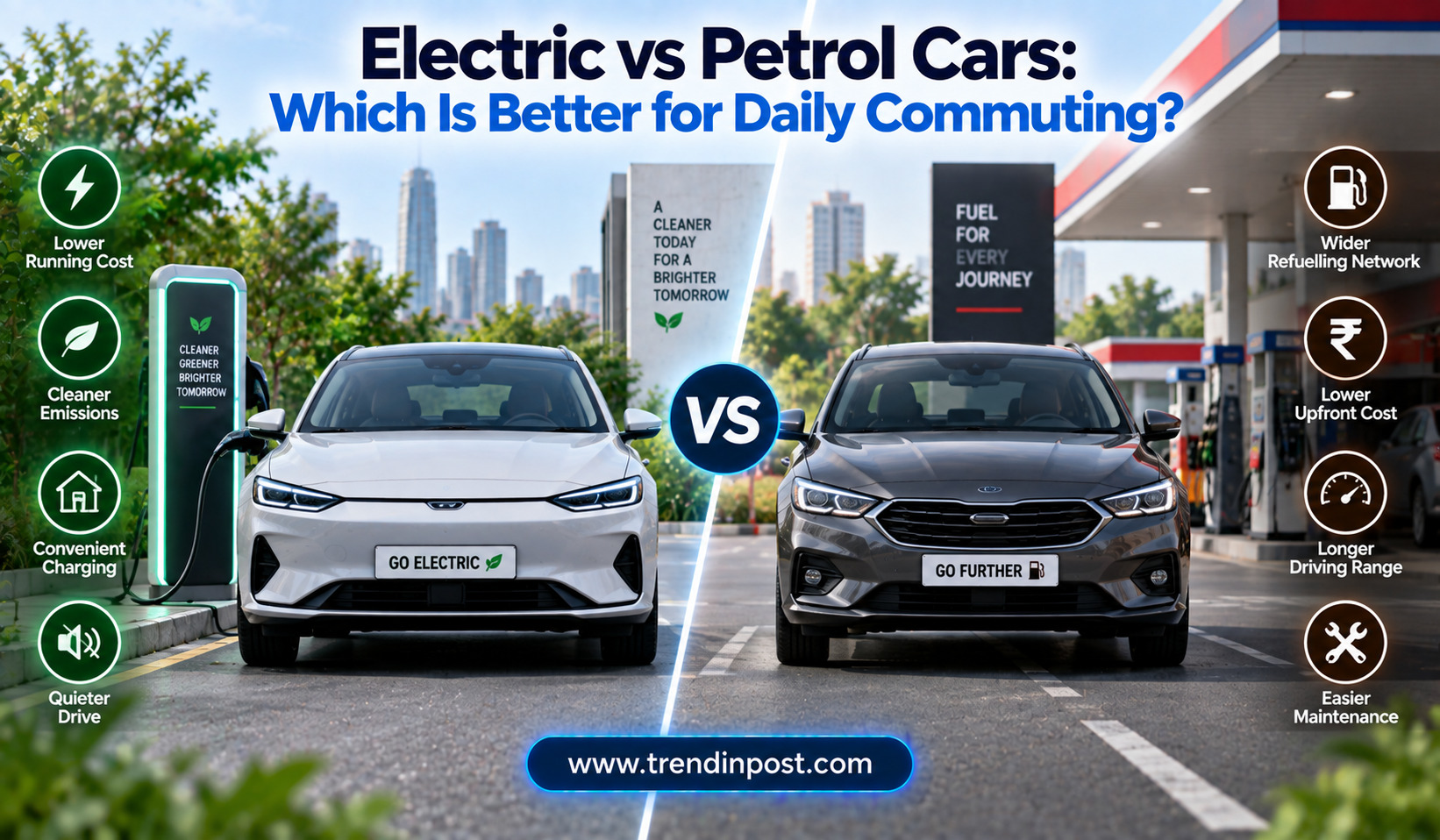
Electric vs Petrol Cars: Which Is Better for Daily Commuting?
The choice between an electric car and a petrol car is becoming increasingly relevant for people who use their vehicles every day. Daily commuters generally look for a combination of low running costs, convenience, comfort and dependable performance. While petrol cars continue to dominate many parts of the Indian market, electric vehicles are gaining attention as charging infrastructure expands and more affordable EV models enter the market.
For someone travelling to work every day, the decision is not simply about choosing between an electric motor and a petrol engine. The ideal option depends on the daily distance, traffic conditions, access to charging, purchase budget and expectations for long-distance travel.
Both technologies have their strengths. Petrol cars offer familiar refuelling and broad flexibility, while electric cars can provide quieter operation and potentially lower day-to-day energy costs. Understanding these differences can help commuters decide which powertrain better matches their routine.
How Daily Commuting Changes the Equation
A car used primarily for commuting can have a very different ownership pattern from one used only occasionally. A daily driver may cover several hundred kilometres every month, making fuel or electricity costs an important part of the overall budget.
Traffic conditions also matter. Stop-and-go urban driving can affect petrol efficiency, particularly when the engine spends considerable time idling or operating at low speeds. Electric motors, meanwhile, can deliver power efficiently in city conditions and do not need to remain running while the car is stationary.
However, daily commuting also creates a predictable usage pattern, which can benefit EV owners. If the driver travels a similar distance every weekday and can charge at home overnight, planning energy use can become relatively straightforward.
Petrol Cars Still Offer Refuelling Convenience
One of the biggest advantages of petrol cars is the established refuelling network. Petrol stations are widely available across Indian cities, highways and smaller towns. Drivers can generally refill a vehicle within a few minutes and continue their journey.
This flexibility becomes particularly useful for commuters who occasionally make unexpected long-distance trips. A petrol car does not require advance planning around charging locations, and drivers can refuel whenever necessary.
Petrol technology is also familiar to most drivers, mechanics and service centres. This established ecosystem can make ownership relatively straightforward, especially for buyers purchasing their first car.
The disadvantage is that petrol prices can make daily running costs significant for high-mileage users. Actual fuel expenses depend on the vehicle’s efficiency, traffic conditions and the driver’s annual distance.
Electric Cars Can Reduce Everyday Energy Costs
Electric cars have a different operating model. Instead of purchasing petrol every time the battery needs energy, owners can charge the vehicle at home, at work or at public charging stations where available.
For a commuter with access to home charging, this can be particularly convenient. The vehicle can be plugged in after returning from work and be ready for the next day’s journey without requiring a separate visit to a fuel station.
Electric motors are also mechanically simpler than conventional internal-combustion powertrains in several respects. They do not require engine oil changes or many of the components associated with conventional petrol engines.
However, electricity costs vary by location and charging arrangement. Public fast charging can also cost more than home charging, so the financial advantage depends partly on how the vehicle is charged.
Purchase Price Is an Important Difference
The upfront price can make petrol cars attractive to buyers working with a limited budget. Petrol models are available across a wide range of segments, including affordable hatchbacks and compact cars.
Electric cars can have a higher initial purchase price in comparable segments because of the cost of their battery systems and electric powertrain technology. Government policies and incentives can influence the final cost, but these vary over time and by location.
For a daily commuter, the higher purchase price of an EV needs to be considered alongside potential savings in energy and maintenance. A buyer who drives only a small distance each month may take longer to recover the additional upfront expense than someone covering a substantial daily distance.
Charging vs Refuelling
The biggest lifestyle difference between the two technologies is how energy is added to the vehicle.
Petrol cars can usually be refuelled in a matter of minutes. EV charging takes longer, although fast-charging technology can significantly reduce waiting times compared with slower chargers.
For a commuter, home charging can make this difference less important. The car can be connected while parked overnight, meaning the charging process happens during a period when the owner is not using the vehicle.
The situation changes for people who live in apartments without dedicated parking or charging facilities. Public charging may then become an important part of the ownership routine.
Before purchasing an EV, buyers should investigate whether they can conveniently charge where they live or work.
Running Costs Over the Long Term
Running costs are one of the strongest arguments in favour of electric cars for regular commuters. Electricity can cost less per kilometre than petrol depending on local energy prices, vehicle efficiency and charging method.
Maintenance can also be different. Electric cars generally have fewer moving mechanical components in their powertrains, which can reduce the need for certain routine services. However, EV ownership still involves tyres, brakes, suspension components, air-conditioning systems and other maintenance requirements.
Petrol cars have a longer-established service structure. Routine servicing can include engine oil, filters, spark plugs and other components depending on the vehicle.
The actual long-term cost therefore depends on the individual model rather than the powertrain alone.
Performance in City Traffic
Electric cars can be particularly smooth in urban environments. Electric motors deliver torque almost immediately, allowing the vehicle to respond quickly when moving away from traffic lights or joining a busy road.
The absence of traditional gear changes can also make the driving experience feel simple and smooth. Regenerative braking can further reduce the need for frequent brake-pedal use in some driving situations.
Petrol cars have their own advantages. Modern petrol engines, particularly turbocharged units, can provide strong acceleration and good highway performance. Automatic transmissions can also make petrol-powered cars comfortable in congested traffic.
For a daily city commute, the choice may come down to whether the buyer prioritises EV smoothness and quietness or the familiar characteristics of a petrol powertrain.
Highway Travel Changes the Comparison
Daily commuting may not be the only purpose of a car. Many owners also use their vehicles for weekend trips and family holidays.
Petrol cars generally have an advantage in long-distance flexibility because refuelling is quick and petrol stations are widespread. An EV can also travel long distances, but journey planning may require greater attention to charging locations, charging time and traffic conditions.
Battery range can also be affected by driving speed, temperature, air-conditioning use and passenger load. These factors mean that the real-world range of an EV may differ from its certified figure.
For buyers who mostly commute within a predictable urban area, this may not be a major concern. For frequent highway travellers, it can be more important.
Environmental Considerations
Electric cars produce no tailpipe emissions while driving, making them attractive to buyers who want to reduce local vehicle emissions.
Petrol cars burn fossil fuel and produce exhaust emissions during operation. However, the environmental impact of an EV is more complex than simply looking at tailpipe emissions because electricity generation and battery manufacturing also have environmental impacts.
The overall environmental benefit of an EV depends partly on how electricity is generated and how efficiently the vehicle is used. Nevertheless, the absence of tailpipe emissions is one reason electric mobility is receiving greater attention in urban areas.
Which Option Fits Different Commuters?
| Factor | Electric Car | Petrol Car |
| City commuting | Excellent for many users | Good |
| Refuelling speed | Slower | Very fast |
| Home charging | Major advantage | Not applicable |
| Long-distance flexibility | Requires more planning | Excellent |
| Routine powertrain maintenance | Generally lower complexity | More routine components |
| Upfront price | Often higher in comparable models | Usually broader range |
| Driving refinement | Quiet and smooth | Depends on engine/transmission |
| Energy cost | Potentially lower | Depends on fuel efficiency and petrol price |
| Charging infrastructure | Still developing | Widely established |
Battery Life Should Not Be Ignored
For an EV buyer, the battery is one of the most important components to understand. Modern EV batteries are designed to provide years of use, but their capacity can gradually decline over time.
Buyers should examine the manufacturer’s battery warranty and understand what it covers. Warranty duration and conditions vary between manufacturers and models.
Battery performance can also be influenced by charging habits, climate and usage patterns. An EV should therefore be considered as a complete ownership package rather than simply a car with a large battery.
What Should Daily Commuters Prioritise?
The ideal powertrain depends heavily on individual circumstances. An EV may be particularly suitable for a commuter who has a fixed daily route, predictable mileage and reliable home charging.
A petrol car may be more appropriate for someone who regularly travels long distances, lives without convenient charging access or wants the widest possible refuelling flexibility.
Before deciding, buyers should consider:
- Average daily and monthly kilometres
- Availability of home or workplace charging
- Expected highway usage
- Purchase budget and financing
- Local electricity and petrol costs
These factors can be more useful than simply comparing the headline specifications of two cars.
The Importance of a Realistic Test Drive
A test drive should be used to understand how the vehicle behaves in the conditions where it will actually be used. For an office commuter, this means testing low-speed acceleration, braking, steering and cabin comfort.
EV buyers should also experience regenerative braking because its behaviour can feel different from that of a conventional petrol car. Petrol-car buyers should pay attention to clutch operation or automatic transmission behaviour in slow traffic.
The driving position, air-conditioning performance, infotainment system and parking visibility are equally important because these are features the owner may use almost every day.
Final Verdict
There is no universal winner in the electric-versus-petrol debate for daily commuting. The better choice depends on how predictable the driver’s routine is and what infrastructure is available around them.
Electric cars can be highly attractive for urban commuters who have convenient charging access. Their quiet operation, instant response and potentially lower energy and maintenance costs can make them well suited to repeated daily journeys.
Petrol cars remain a practical choice for buyers who value quick refuelling, widespread infrastructure and unrestricted long-distance flexibility. They can also provide a lower entry point in many segments.
For most buyers, the smartest decision is to calculate the real cost of ownership based on their own driving pattern. The car that fits the commute, charging or refuelling situation, budget and long-term usage is likely to be the better choice.
FAQs
1. Is an electric car better than a petrol car for daily commuting?
An electric car can be better for daily commuting when the driver has convenient charging access and follows a predictable route. Petrol may be more practical for drivers who frequently travel long distances.
2. Are EVs cheaper to run than petrol cars?
They can be, particularly when charging is done at home at favourable electricity rates. Actual savings depend on electricity prices, petrol prices, vehicle efficiency and annual mileage.
3. Is charging an EV more difficult than refuelling a petrol car?
Charging takes longer than petrol refuelling, but home charging can make the process convenient because the vehicle can charge while parked overnight.
4. Which is better for heavy city traffic?
Electric cars can work particularly well in heavy traffic because of their smooth power delivery, quiet operation and regenerative braking. A petrol car with a well-tuned automatic transmission can also be comfortable in urban conditions.
5. Are petrol cars better for long road trips?
Petrol cars generally offer greater convenience for long trips because refuelling is quick and fuel stations are widely available. EVs can also be used for road trips but may require more journey planning.
Related Post

How Ground Clearance Affects Everyday Car Driving
Ground clearance is one of the car specifications that often gets overlooked until a vehicle…