What to Look for When Buying a Car for Daily Office Commutes
>> Automobile>> What to Look for When Buying a Car for Daily Office Commutes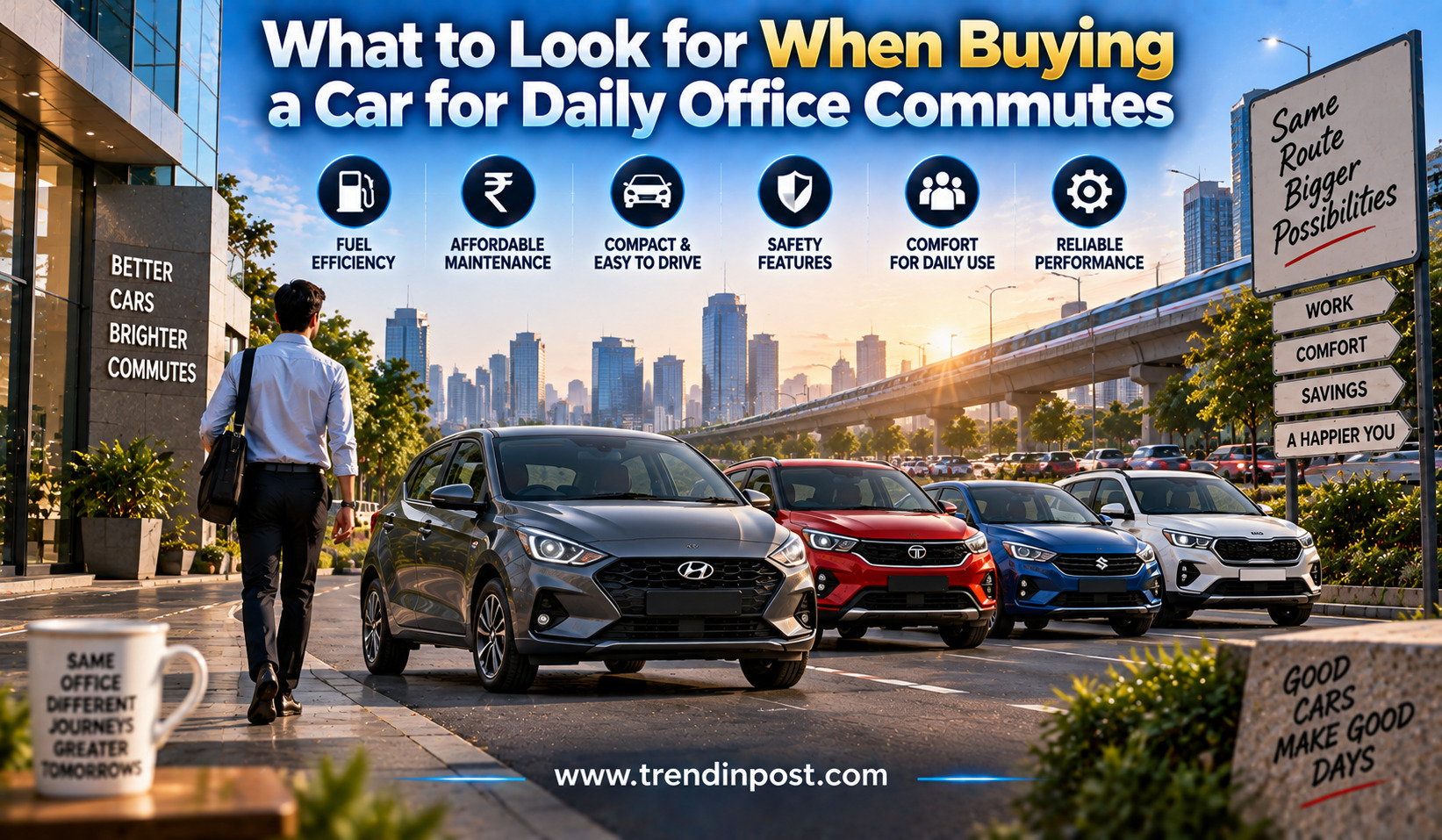
What to Look for When Buying a Car for Daily Office Commutes
For many car buyers, the vehicle is not primarily used for weekend road trips or occasional family outings. It becomes part of the daily routine, taking the driver to work and back through traffic, busy intersections, narrow streets and crowded parking areas. Because of this, choosing a car for a daily office commute requires a different approach from choosing one based only on styling or performance.
A commuter car needs to be comfortable, easy to operate, economical to run and practical enough to handle everyday traffic. Features such as fuel efficiency, automatic transmission, comfortable seats and useful connectivity can make a noticeable difference when the same journey is repeated several times a week.
With hatchbacks, sedans, compact SUVs and electric cars now competing for buyers, understanding what actually matters for a regular office commute can help avoid an expensive mistake.
Start With Your Daily Driving Pattern
Before comparing car models, buyers should understand how they actually travel to work. A person driving 10 km through heavy city traffic has different requirements from someone travelling 40 or 50 km primarily on highways.
Traffic conditions, road quality, parking availability and the average distance travelled each day can influence the ideal vehicle. A compact car may be easier to handle in a crowded city, while a larger vehicle could make more sense for someone who spends considerable time on highways.
The daily route also affects the importance of fuel economy. If the car is driven for several hours every week, even a small difference in efficiency can become meaningful over a year.
Fuel Efficiency Can Reduce Daily Running Costs
Fuel expenses are among the most important considerations for office commuters. Unlike occasional car users, daily commuters may accumulate thousands of kilometres over a year.
Petrol cars remain popular because of their widespread availability and relatively straightforward ownership. Diesel vehicles can still appeal to high-mileage users in appropriate segments, although buyers need to consider the model’s availability, maintenance requirements and future usage.
Hybrid and electric vehicles provide another option for commuters. EVs can be particularly attractive for people who have predictable daily routes and access to convenient charging. However, charging availability and longer-trip requirements should be evaluated before making the switch.
Buyers should avoid selecting a car solely because its claimed mileage is high. Real-world consumption can vary depending on traffic, driving style, air-conditioning use, passenger load and road conditions.
Automatic Transmission Can Make Traffic Easier
For people who spend a significant amount of time in stop-and-go traffic, transmission choice can have a major effect on driving comfort.
Manual transmissions provide direct control and remain popular among Indian buyers. However, repeatedly operating the clutch and changing gears in congested traffic can become tiring, especially during long commutes.
Automatic transmissions remove much of this effort. Depending on the model, buyers may encounter AMT, torque-converter automatic, CVT, DCT or other automatic technologies. Each type offers a different balance of smoothness, performance, efficiency and cost.
A commuter should test the transmission in slow traffic rather than judging it only during a short open-road test drive. Smooth low-speed behaviour is particularly important for everyday city use.
Comfortable Seats Matter More Than Expected
Office commuters can spend hundreds of hours inside their cars each year. This makes seat comfort one of the most important characteristics, even though it rarely receives as much attention as engine specifications.
The driver’s seat should provide adequate thigh support and allow enough adjustment for different body types. The steering wheel should also be positioned comfortably so that the driver does not need to stretch or adopt an awkward posture.
Seat comfort should be evaluated over more than a few minutes. During a test drive, buyers should pay attention to lower-back support, visibility and whether their legs remain comfortable while operating the pedals.
A well-designed driving position can make a daily commute feel significantly less tiring.
Compact Dimensions Can Be Useful in Cities
Office commuters frequently encounter narrow lanes, crowded parking lots and congested streets. In such environments, the physical dimensions of a vehicle can become more important than its exterior appearance.
Compact hatchbacks and smaller SUVs are generally easier to manoeuvre in tight spaces. A smaller turning circle can also make U-turns and parking easier.
However, buyers should not automatically assume that the smallest vehicle is the best commuter. Cabin space, boot capacity and highway comfort still matter, particularly when the car is used for both office travel and family requirements.
Parking Assistance Can Improve Convenience
Parking can be one of the most frustrating parts of a daily commute. A car that is comfortable to drive but difficult to park can quickly become inconvenient.
Rear parking sensors are now common on many models, while higher variants may offer reversing cameras, front sensors or a 360-degree camera system. These technologies can make it easier to judge the vehicle’s surroundings in crowded office parking areas.
A reversing camera can be especially useful for drivers who regularly park in tight spaces. However, these systems should supplement careful observation rather than replace it.
Infotainment Should Be Useful, Not Distracting
Modern commuters spend considerable time connected to their smartphones, making infotainment an important part of the ownership experience.
Wireless or wired Apple CarPlay and Android Auto can provide access to navigation, calls and selected media applications through the vehicle’s display. Bluetooth connectivity is also useful for hands-free calling and audio.
A good infotainment system should be relatively easy to understand. Complicated menus can become frustrating when the driver needs to perform simple tasks.
Voice controls can also be useful for certain functions because they reduce the need to interact physically with the screen while driving.
Air Conditioning Is Important for Indian Commutes
Climate control should not be treated as a minor comfort feature in India. Summer temperatures can make the cabin uncomfortable within minutes, particularly when a vehicle is parked outdoors during working hours.
An effective air-conditioning system with good rear airflow can improve comfort during the daily journey. Automatic climate control can make temperature management easier, although a conventional manual system can also work effectively when properly designed.
Buyers should test the air-conditioning system during a test drive and check how quickly the cabin cools. Rear passengers should also be considered if the car is regularly used by colleagues or family members.
Safety Should Remain a Priority
A commuter may spend much of the journey at relatively low speeds, but that does not make safety equipment less important. Urban traffic can involve sudden braking, motorcycles, pedestrians and unpredictable lane changes.
Buyers should look at the complete safety package of the specific variant rather than relying only on the overall model reputation.
Important features can include:
- Multiple airbags
- ABS and Electronic Brakeforce Distribution
- Electronic Stability Control
- Hill-hold assistance
- Parking sensors and rear camera
- ISOFIX child-seat mounts
Higher-priced models may also offer advanced driver-assistance features. These can provide additional support, but the driver remains responsible for maintaining attention and control.
Ride Quality for Uneven Roads
A daily commute is rarely limited to perfectly maintained roads. Potholes, speed breakers, construction zones and rough patches can be part of the route.
Suspension tuning therefore has a direct effect on commuter comfort. A vehicle that absorbs smaller bumps without excessive movement can make repeated journeys less tiring.
Large wheels and low-profile tyres may look attractive, but they can sometimes transmit more road impact into the cabin. Buyers should therefore evaluate ride quality rather than choosing wheel sizes based solely on appearance.
Engine Performance Should Be Balanced
A commuter does not necessarily need a powerful engine. What matters more is smooth and predictable performance in the conditions where the car will be used.
For city driving, responsive low-speed acceleration can make merging into traffic easier. For highway commuters, sufficient power for overtaking becomes more important.
Turbocharged petrol engines can provide strong performance from smaller engine capacities, while naturally aspirated engines may appeal to buyers who prefer predictable power delivery. The best choice depends on the vehicle, transmission and driving pattern.
Compare the Main Commuter Priorities
| Factor | Why It Matters for Office Commutes | What to Check |
| Fuel efficiency | Helps control regular running costs | Real-world economy |
| Transmission | Affects traffic comfort | Low-speed smoothness |
| Seat comfort | Important during repeated journeys | Support and adjustment |
| Vehicle size | Makes parking and manoeuvring easier | Turning radius and visibility |
| Air conditioning | Essential for hot weather | Cooling speed and rear airflow |
| Safety | Protects occupants during unexpected situations | Variant-wise equipment |
| Infotainment | Helps with navigation and connectivity | Smartphone integration |
| Ride quality | Reduces fatigue on rough roads | Suspension performance |
Consider Total Ownership Cost
The purchase price should not be the only financial consideration. A commuter vehicle can accumulate substantial mileage, meaning fuel, insurance, servicing and tyre costs can have a significant effect on long-term expenses.
A car with a slightly higher initial price may make sense if it offers better efficiency or lower routine maintenance costs. Conversely, expensive features that are rarely used may not provide much practical value.
Buyers should estimate their annual driving distance and calculate approximate fuel expenses before making a final decision. This approach provides a clearer picture of what the car could cost over several years.
Petrol, Hybrid or Electric for Commuting?
The choice of powertrain is becoming more complicated as electric and hybrid vehicles enter more segments.
Petrol remains a straightforward option for buyers who want easy refuelling and flexibility. Hybrid vehicles can be attractive for drivers looking for improved efficiency without depending entirely on charging infrastructure.
Electric cars can be particularly suitable for predictable office commutes when home or workplace charging is available. Their quiet operation and instant torque can also make urban driving pleasant.
However, an EV buyer should consider charging access, daily range requirements and occasional long-distance travel before making a decision.
Test the Car on Your Actual Needs
A proper test drive can reveal characteristics that specifications cannot. Buyers should try the car in slow traffic, test the brakes, evaluate steering weight and check how easily they can park.
The driving position should be comfortable, and important controls should be within easy reach. Rear-seat passengers should also have enough room if the vehicle will regularly carry colleagues or family members.
Before finalising the purchase, commuters should ideally evaluate:
- City driving behaviour
- Parking and visibility
- Seat and suspension comfort
- Air-conditioning performance
- Transmission response
Final Thoughts
The ideal car for a daily office commute is not necessarily the most powerful, largest or most feature-loaded model. It should instead make repetitive daily travel easier, more comfortable and more predictable.
Fuel efficiency, comfortable seats, easy manoeuvrability, smooth transmission behaviour and effective air conditioning can have a greater impact on everyday ownership than features that look impressive on a specification sheet.
Safety should remain a core priority, while practical technology such as smartphone connectivity, parking sensors and a reversing camera can make the routine more convenient. Buyers should also consider total ownership costs because a commuter car can cover a considerable distance during its lifetime.
Ultimately, the right commuter car is the one that fits the driver’s route, budget and lifestyle. A careful test drive combined with realistic calculations for fuel, maintenance and usage can help buyers select a vehicle that remains satisfying long after the initial excitement of purchase has faded.
FAQs
1. What is the most important feature in a car for office commuting?
There is no single feature, but fuel efficiency, comfort, safety and ease of driving are among the most important characteristics for regular commuters.
2. Is an automatic car better for daily office travel?
An automatic can be more convenient in heavy traffic because it reduces the need for repeated clutch and gear operation. However, the best transmission depends on the buyer’s preferences and budget.
3. Should office commuters choose a small car?
A compact car can be easier to park and manoeuvre in crowded cities. However, buyers should also consider cabin space, boot capacity and highway requirements.
4. Is an electric car suitable for daily office commuting?
An EV can work very well for predictable daily routes, particularly when convenient home or workplace charging is available. Buyers should assess charging access and occasional long-distance requirements.
5. How important is air conditioning in a commuter car?
It is highly important in India’s climate. Buyers should check how quickly the cabin cools and whether rear passengers receive sufficient airflow.
Related Post

Affordable Cars With Features in More Expensive Models
The Indian car market has changed significantly in recent years, with buyers increasingly expecting more…