
Electric SUVs vs Petrol SUVs: Comparing Everyday Practicality
>> Automobile>> Electric SUVs vs Petrol SUVs: Comparing Everyday Practicality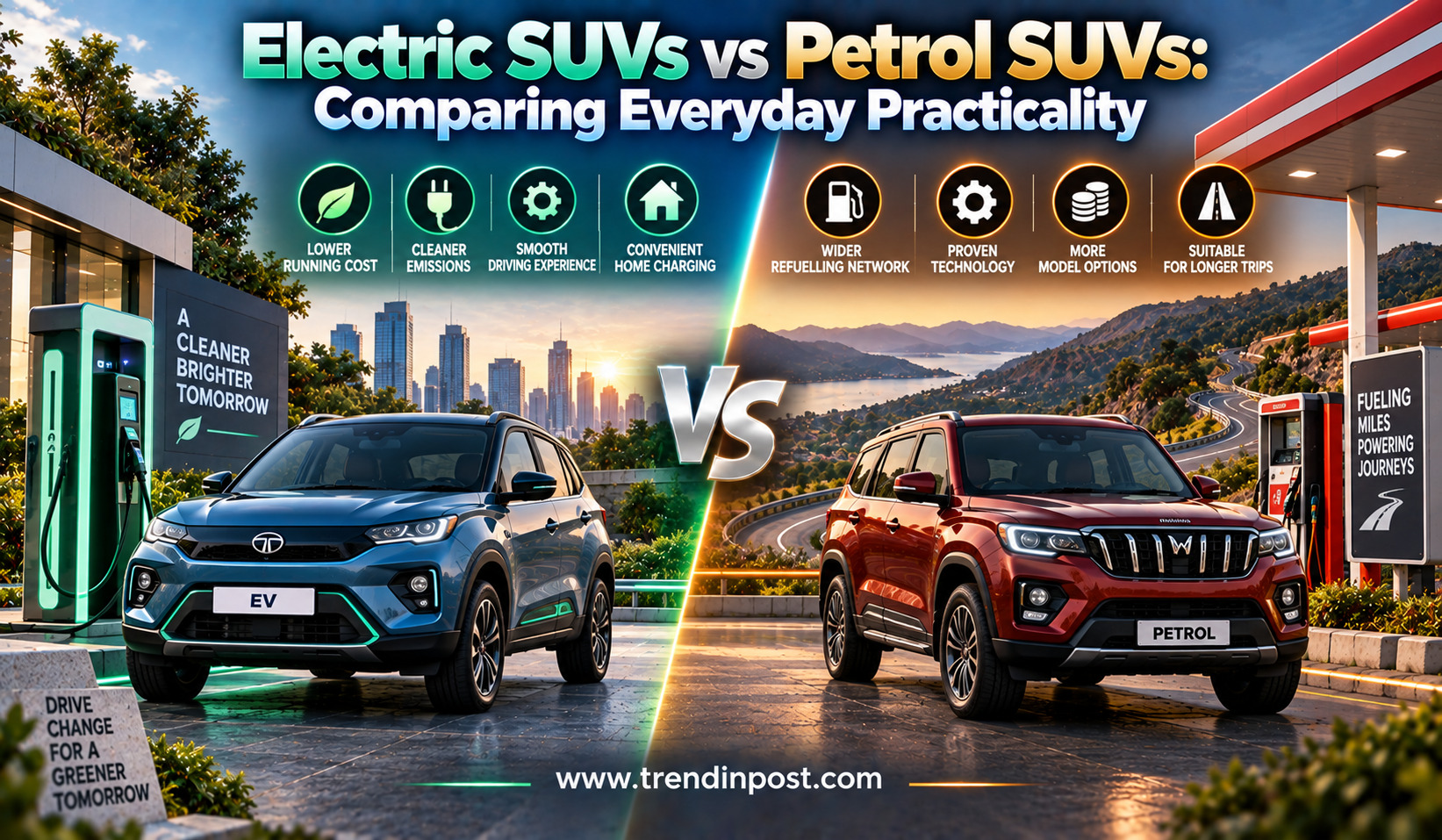
Electric SUVs vs Petrol SUVs: Comparing Everyday Practicality
SUVs have become a popular choice for Indian buyers because they offer a combination of road presence, cabin space, higher seating position and everyday versatility. As the market changes, buyers now have another decision to make alongside choosing the size and brand of an SUV: should they go electric or stay with a petrol engine?
Electric SUVs and petrol SUVs can both work well for daily driving, but their ownership experience is quite different. The difference is not limited to fuel versus electricity. Charging convenience, driving range, running costs, highway travel, maintenance, luggage space and even the availability of infrastructure can influence which type makes more sense.
For buyers planning to use an SUV for office commutes, family trips and occasional long-distance travel, understanding these practical differences is more important than simply comparing performance figures.
Daily Driving Experience
The biggest difference between an electric SUV and a petrol SUV can be felt during everyday driving. Electric SUVs deliver power almost instantly, making them particularly comfortable in city traffic. There is no conventional gear-shifting process, and acceleration is generally smooth and quiet. Frequent stop-and-go driving can therefore feel less tiring.
Petrol SUVs, on the other hand, use an internal-combustion engine and gearbox. Modern automatic transmissions have made petrol SUVs considerably easier to drive in traffic, while manual variants remain popular among buyers who prefer greater control and lower initial costs.
For short urban journeys, an electric SUV can feel particularly effortless. The quiet cabin and smooth power delivery are useful when driving through crowded roads. A petrol SUV may feel more familiar to buyers who have spent years driving conventional cars.
Running Costs Can Change the Ownership Equation
Running cost is one of the strongest arguments in favour of electric SUVs. Electricity used for charging can cost less per kilometre than petrol, particularly when the vehicle is regularly charged at home. This advantage becomes more noticeable for people who drive long distances every month.
Petrol prices, meanwhile, can have a direct effect on the monthly running cost of a petrol SUV. Fuel efficiency also varies according to traffic, driving style, engine size and vehicle weight. A larger petrol SUV with a powerful engine can consume considerably more fuel than a smaller model.
However, the real savings from an electric SUV depend on how it is charged. Home charging can make an EV much more economical, while frequent reliance on public fast chargers may reduce some of the cost advantage.
Charging vs Refuelling
Charging is probably the most important practical difference between the two SUV types. A petrol SUV can usually be refuelled within a few minutes, making it convenient for long journeys. Fuel stations are also widely available across Indian cities, highways and smaller towns.
Electric SUVs require more planning. A home charger can make daily ownership easy because the vehicle can be charged while the owner is sleeping or working. For people with access to dedicated parking and charging, this can actually be more convenient than visiting a fuel station regularly.
The situation becomes different during long-distance travel. EV owners need to consider charging locations and available charging time. Petrol SUV owners generally have greater freedom to stop at almost any fuel station along a route.
The practical choice therefore depends heavily on parking and charging access.
Range and Long-Distance Travel
Electric SUV range has improved significantly, but claimed range should not be treated as a guarantee of real-world driving distance. Traffic, speed, air-conditioning use, road conditions, temperature and driving style can all influence actual efficiency.
A petrol SUV also experiences changes in fuel economy under different conditions, but its long-distance practicality is supported by the established fuel network. A quick refuelling stop can add substantial driving distance without requiring the owner to spend much time waiting.
For people whose SUV is primarily used inside the city, EV range may not be a major concern. A vehicle with sufficient real-world range for several days of commuting can be very convenient.
For buyers who frequently travel between cities, visit remote locations or take unpredictable road trips, petrol still has a practical advantage because refuelling infrastructure is easier to find.
Space and Family Practicality
SUV buyers often prioritise interior space, boot capacity and passenger comfort. Both electric and petrol SUVs can provide generous cabin space, but the placement of mechanical components differs.
An electric SUV does not need a conventional engine and gearbox layout, which gives manufacturers greater flexibility when designing the vehicle. The battery pack is usually positioned low in the vehicle, helping with weight distribution and cabin packaging.
Petrol SUVs need space for the engine, transmission, fuel system and related mechanical components. Despite this, modern petrol SUVs can still offer excellent passenger and luggage space.
For families, the actual model matters more than the powertrain alone. A compact electric SUV may have less usable luggage space than a larger petrol SUV, while a larger electric model can easily compete with conventional SUVs in terms of cabin comfort.
Maintenance and Ownership
Maintenance is another area where electric SUVs can have an advantage. Electric powertrains contain fewer moving components than conventional petrol engines. There is no engine oil change, and several traditional engine-related maintenance requirements are eliminated.
That does not mean EVs are maintenance-free. Tyres, brakes, suspension components, air-conditioning systems and other parts still require attention. Battery condition and the vehicle’s electronic systems are also important aspects of long-term ownership.
Petrol SUVs require regular servicing involving engine oil, filters and other mechanical components. Maintenance costs can vary significantly between brands and models.
For buyers who prefer a simpler mechanical powertrain and potentially lower routine servicing requirements, an EV can be attractive. Petrol SUVs remain easier to understand and service in many parts of the country because conventional automotive workshops are widespread.
Performance and Driving Feel
Electric SUVs often feel quicker from a standstill because their motors can deliver strong torque immediately. This makes overtaking and moving away from traffic lights feel effortless.
Petrol SUVs provide a different driving character. Turbocharged petrol engines can offer strong performance at higher speeds, while naturally aspirated engines tend to deliver smoother and more predictable power delivery.
The driving experience ultimately depends on what the buyer values. EVs generally focus on instant response and smoothness, while petrol SUVs can provide the familiar engine sound, gear changes and longer high-speed driving range that many enthusiasts appreciate.
Everyday Practicality: EV vs Petrol SUV
| Factor | Electric SUV | Petrol SUV |
| City driving | Very convenient and quiet | Convenient, especially with automatic |
| Running cost | Usually lower with home charging | Generally higher due to fuel costs |
| Refuelling/charging time | Longer | Usually only a few minutes |
| Long-distance travel | Requires charging planning | Easier due to fuel availability |
| Routine maintenance | Generally simpler | More regular mechanical servicing |
| Home infrastructure | Charging access is important | No special setup required |
| Driving experience | Smooth and instant | Familiar engine-powered experience |
| Highway flexibility | Depends on charging network | Strong advantage |
| Environmental impact | No tailpipe emissions | Produces tailpipe emissions |
| Best suited to | City-heavy users with charging access | Mixed-use and frequent long-distance users |
Which SUV Makes More Sense for a Daily Commute?
For a buyer whose regular routine involves travelling to work, shopping, school runs and other urban activities, an electric SUV can be a highly practical option. If the vehicle can be charged at home overnight, the owner may rarely need to visit a charging station.
The calculation becomes different for someone who does not have a fixed parking space or cannot install a home charger. In such cases, depending entirely on public charging can make daily ownership less convenient.
A petrol SUV remains the safer practical choice for buyers who want maximum flexibility. It can be used for short trips during the week and long highway journeys at the weekend without much planning.
What About Family Road Trips?
Family road trips can expose the differences between the two powertrains. Petrol SUVs have a clear advantage when travelling through areas where charging stations are limited. A fuel stop can be completed quickly, allowing the journey to continue with minimal interruption.
Electric SUVs can also be excellent road-trip vehicles when routes have reliable charging infrastructure. Their quiet cabins and smooth acceleration can make long journeys comfortable. However, the trip needs more preparation, particularly when travelling to less-developed areas.
Before choosing an EV for frequent road trips, buyers should check the availability of charging stations along their usual routes rather than relying only on the vehicle’s claimed range.
Purchase Price and Long-Term Value
The purchase price is another important consideration. Electric SUVs can carry a higher upfront price in some segments because of the cost of their battery systems. However, lower running and maintenance expenses may help offset part of the initial difference over time.
Petrol SUVs can offer a wider selection across different price points. Buyers also have more choices between manual and automatic transmissions, engine sizes and body styles.
The better financial choice depends on annual driving distance and ownership period. Someone travelling a high number of kilometres every year may benefit more from lower EV running costs, while a low-mileage buyer may place greater importance on purchase price and convenience.
Petrol SUVs Still Have a Strong Practical Case
The growing popularity of electric SUVs does not mean petrol SUVs have become outdated. They remain highly practical for buyers who regularly travel long distances, live in areas with limited charging infrastructure or do not have access to private parking.
Petrol SUVs also offer a mature ownership ecosystem. Fuel stations, service centres, mechanics and spare parts are widely available. This can provide peace of mind for buyers who travel frequently across different parts of India.
Electric SUVs, meanwhile, are becoming increasingly attractive as charging infrastructure expands and battery technology develops. For urban users with predictable daily driving patterns, their smooth performance and lower running costs can make a strong case.
How Buyers Can Make the Right Choice
Before deciding between an electric and petrol SUV, buyers should look at their actual driving routine instead of choosing purely based on technology or fuel preference.
A few practical questions can make the decision easier:
- How many kilometres are driven in a typical month?
- Is home or workplace charging available?
- How often does the vehicle travel on highways?
- Is the SUV expected to visit areas with limited charging infrastructure?
The answer to these questions can reveal which powertrain fits the owner’s lifestyle more naturally.
Final Thoughts
Electric SUVs and petrol SUVs are both practical, but they are practical in different ways. An electric SUV can be an excellent everyday vehicle for urban users who have reliable charging access. Its quiet operation, instant response and potentially lower running costs make it appealing for regular city use.
A petrol SUV continues to offer greater flexibility, particularly for long-distance travel and buyers without convenient charging facilities. Its established refuelling and servicing network remains a major advantage.
Ultimately, there is no universal winner. The better SUV is the one that matches the owner’s driving pattern, charging or refuelling access, budget and travel requirements. As electric infrastructure continues to develop, the gap in everyday convenience is likely to become smaller, giving buyers even more choice in the SUV market.
FAQs
Are electric SUVs cheaper to run than petrol SUVs?
In many cases, yes. Charging an EV at home can cost less per kilometre than running a petrol SUV, although the actual saving depends on electricity rates, petrol prices, vehicle efficiency and annual usage.
Is an electric SUV practical for daily office travel?
Yes. An EV can be particularly convenient for daily commuting when home or workplace charging is available. Regular short and medium-distance trips are well suited to electric vehicles.
Which is better for long road trips, an EV or petrol SUV?
Petrol SUVs currently have an advantage in flexibility because fuel stations are widely available and refuelling takes little time. EV road trips can also work well when reliable charging infrastructure is available along the route.
Do electric SUVs require less maintenance?
Electric SUVs generally have fewer powertrain components and do not require engine oil changes. However, tyres, brakes, suspension, air-conditioning and electrical systems still require regular inspection and servicing.
Are electric SUVs good for families?
Yes. Many electric SUVs offer spacious cabins, comfortable seating and useful luggage capacity. However, buyers should compare the actual interior and boot space of individual models rather than assuming every EV has the same practicality.
Related Post

Car Safety Features Worth Paying More for in 2026
Car buyers in 2026 have more safety technology to choose from than ever before. Even…