
Front-Wheel Drive vs All-Wheel Drive: What Changes for Drivers?
>> Automobile>> Front-Wheel Drive vs All-Wheel Drive: What Changes for Drivers?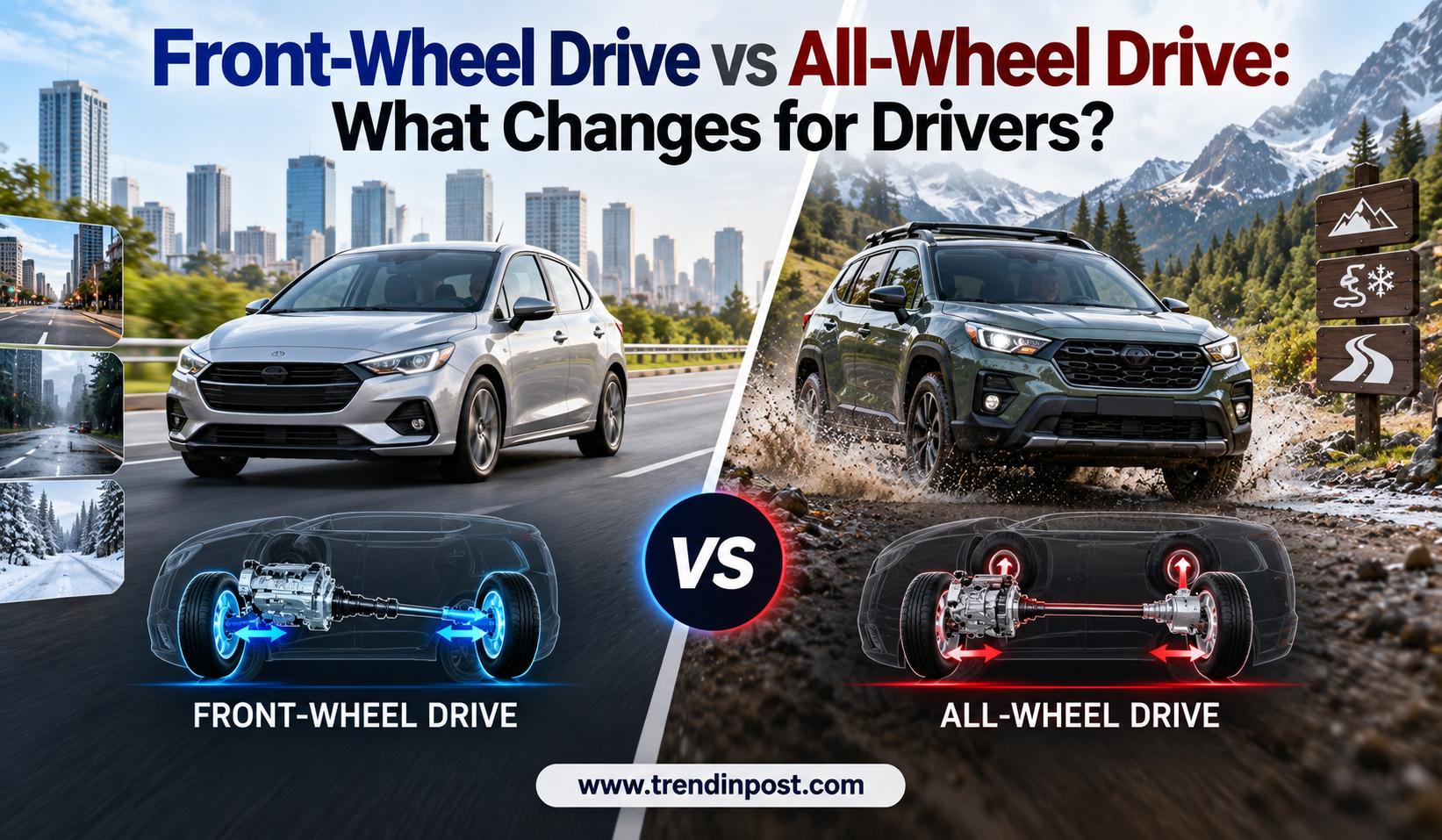
Front-Wheel Drive vs All-Wheel Drive: What Changes for Drivers?
When buying a new car or SUV, buyers often focus on engine performance, mileage, features and safety equipment. However, another important factor can significantly influence how a vehicle behaves on the road: its drivetrain. Front-wheel drive (FWD) and all-wheel drive (AWD) are two commonly discussed systems, and each offers a different approach to delivering power to the road.
For most everyday drivers, the difference may not become obvious during a normal commute on dry roads. The distinction becomes more noticeable when driving on wet surfaces, loose roads, steep gradients or challenging terrain. AWD can provide additional traction in certain conditions, while FWD generally offers a simpler and more efficient setup for regular road use.
The right choice therefore depends less on which system sounds more advanced and more on where, how and how often the vehicle will be driven.
What Is Front-Wheel Drive?
In a front-wheel-drive vehicle, the engine sends power to the front wheels. The front wheels are responsible for both steering and transmitting engine power to the road. This layout is widely used in hatchbacks, sedans, compact SUVs and many family-oriented vehicles.
One of the biggest advantages of FWD is its relatively straightforward packaging. Because the powertrain components can be arranged efficiently at the front, manufacturers can create spacious cabins without requiring a large transmission system running to the rear axle.
FWD can also be particularly suitable for everyday urban driving. When conditions are normal, drivers generally get predictable handling, good fuel efficiency and a familiar driving experience. For buyers who spend most of their time on paved roads, an FWD vehicle can provide everything they need without the additional hardware associated with AWD.
What Is All-Wheel Drive?
All-wheel drive is designed to send power to all four wheels, either continuously or when the vehicle’s control system determines that additional traction is required. The exact operation varies between vehicles, with some systems automatically adjusting torque distribution according to road conditions and wheel grip.
The main benefit is improved traction when available grip becomes limited. If one axle begins to lose traction, an AWD system can distribute power in a way that helps the vehicle maintain forward movement.
Modern AWD systems are not necessarily designed only for off-road driving. They can also be found in premium cars, performance vehicles and SUVs where additional grip and stability are desirable.
However, AWD does not automatically make a vehicle unstoppable. Tyres, suspension, ground clearance, driver behaviour and electronic stability systems remain important factors in determining how a vehicle performs.
The Difference Drivers Notice Most: Traction
The most important difference between FWD and AWD is how engine power reaches the road. With FWD, only the front tyres are powered. AWD gives the vehicle access to traction through all four wheels.
On a dry road with good tyres, many drivers may notice little difference during normal acceleration. The advantage of AWD becomes more relevant when the available grip decreases.
Wet roads, loose gravel, muddy surfaces and steep inclines can create situations where additional driven wheels are useful. AWD can distribute the available power across more tyres, potentially reducing wheelspin and improving the vehicle’s ability to move forward.
This does not mean an AWD car always stops more quickly or handles every corner better. Braking performance is primarily influenced by tyres, brakes, road conditions and vehicle dynamics. AWD mainly helps with putting power down.
How FWD and AWD Behave in Rain
Rain is one of the most common situations in which buyers consider AWD. On a wet road, tyres have less available grip than they do on a dry surface. An AWD system can help reduce wheelspin during acceleration, particularly when the driver is applying significant power.
For normal city driving in moderate rain, however, FWD is generally adequate when the vehicle has good tires and the driver maintains a sensible speed. Drivers should not assume that AWD eliminates the risks associated with standing water, slippery roads or poor visibility.
Tyre quality remains critical. A well-maintained FWD vehicle with suitable tyres can perform safely in wet conditions, while an AWD vehicle with worn tyres can still have poor grip.
FWD vs AWD for Indian Roads
Indian road conditions vary considerably. A driver may encounter smooth highways, broken urban roads, steep hill sections, gravel roads and muddy rural routes during the same year.
For buyers who mainly drive in cities and on highways, FWD is often a practical choice. It can provide efficient packaging and predictable road behaviour without adding the weight and complexity of an AWD system.
AWD becomes more interesting for buyers who regularly travel to hilly regions, encounter rough or loose surfaces or want additional traction for specific driving conditions. It can also appeal to SUV buyers who frequently take their vehicles beyond ordinary paved roads.
Still, buyers should distinguish AWD from four-wheel drive systems designed specifically for demanding off-road conditions. They are not necessarily interchangeable.
Fuel Efficiency Can Be Different
Drivetrain choice can also influence fuel consumption. An AWD system typically requires additional components to transfer power between the front and rear axles. This can add weight and mechanical losses.
As a result, an AWD version of a vehicle may consume more fuel than an equivalent FWD version, although the actual difference depends on the vehicle, engine, transmission, tyres and AWD technology.
For a buyer who drives many kilometres every month, even a modest difference in efficiency can become noticeable over several years. FWD may therefore make more sense for someone who prioritises running costs and rarely encounters conditions where additional traction is useful.
Purchase Price and Maintenance
AWD systems can increase the purchase price of a vehicle because they require additional drivetrain hardware and control technology. Buyers therefore need to decide whether the added capability is useful enough to justify the extra expense.
Maintenance requirements also vary by manufacturer and system design. AWD vehicles can have additional components that require servicing, although modern systems are engineered for everyday reliability.
FWD vehicles generally have a simpler drivetrain layout. This can make them attractive to buyers who want a straightforward family car with predictable ownership costs.
The difference should not be exaggerated, however. The actual service cost depends heavily on the specific model, manufacturer and maintenance schedule.
FWD vs AWD: Key Differences
| Factor | Front-Wheel Drive | All-Wheel Drive |
| Powered wheels | Front wheels | All four wheels |
| Normal city driving | Excellent | Excellent |
| Wet-road traction | Good with suitable tyres | Additional traction potential |
| Highway use | Very suitable | Very suitable |
| Rough-road capability | Limited by traction and vehicle design | Better traction in many conditions |
| Fuel efficiency | Usually better | Can be lower |
| Vehicle cost | Generally lower | Generally higher |
| Mechanical complexity | Lower | Higher |
| Maintenance | Generally simpler | Can involve additional components |
| Best suited for | Everyday road use | Mixed conditions and added traction needs |
Does AWD Improve Handling?
AWD can improve traction while accelerating, but it should not automatically be considered a guarantee of better handling. Vehicle handling depends on many factors, including suspension tuning, steering, tyres, weight distribution and electronic stability systems.
In performance cars, AWD can help deliver high levels of engine power to the road with less wheelspin. In SUVs, it can provide confidence on loose or slippery surfaces.
However, drivers should understand the limits of the system. AWD cannot overcome the laws of physics. Entering a corner too quickly on a wet road remains dangerous regardless of how many wheels are powered.
What About Off-Road Driving?
AWD can be useful for light off-road conditions, but capability varies significantly from one vehicle to another. Ground clearance, approach and departure angles, suspension travel, tyres and traction-control programming can be just as important as the drivetrain.
A crossover with AWD and road-focused tyres may perform well on gravel or a muddy track but may not be suitable for serious rock crawling or deep mud.
Drivers who frequently explore difficult terrain should therefore evaluate the entire vehicle rather than selecting it based only on an AWD badge.
Which System Is Better for City Drivers?
For the average urban driver, FWD is often enough. Most city journeys take place on paved roads, and modern tyres and electronic safety systems can provide adequate traction during normal conditions.
FWD vehicles can also benefit from lower weight and efficient packaging. This makes them attractive for commuters, families and buyers who prioritise fuel economy.
AWD can still be useful for city drivers who regularly travel through areas with heavy rain, steep roads or poor surfaces. But if those conditions are rare, paying extra for AWD may not provide a meaningful everyday benefit.
When AWD Makes More Sense
AWD becomes easier to justify when the vehicle’s usage regularly involves conditions where traction is limited. Buyers should particularly consider it when they:
- Frequently drive in hilly or mountainous areas.
- Regularly encounter gravel, mud or slippery roads.
- Want additional traction for a powerful SUV or performance vehicle.
- Travel long distances through changing road conditions.
For everyone else, FWD may deliver a better balance of price, efficiency and everyday practicality.
The Importance of Tyres
One point is often overlooked in the FWD-versus-AWD discussion: tyres. The four tyres are the vehicle’s actual contact points with the road, making their condition extremely important.
An AWD system can distribute power between wheels, but it cannot create grip where the tyres have very little traction. Worn tread, incorrect tyre pressure or unsuitable tyres can significantly reduce performance in wet and slippery conditions.
Regular tyre checks and sensible driving are therefore essential regardless of the drivetrain.
Final Thoughts
Front-wheel drive and all-wheel drive serve different purposes. FWD remains a highly practical solution for everyday driving, offering efficient packaging, generally lower costs and predictable road manners. For city commuters and families who spend most of their time on paved roads, it is often the sensible choice.
AWD adds another layer of traction capability. It can be valuable for drivers who regularly face slippery roads, steep gradients, loose surfaces or changing terrain. The additional hardware, weight and cost, however, may not be worthwhile for someone whose driving environment rarely demands it.
Ultimately, the best drivetrain is determined by the driver’s routine rather than the badge on the vehicle. A buyer who understands their roads, driving habits, annual mileage and weather conditions can make a much more informed decision between FWD and AWD.
FAQs
Is AWD better than FWD?
AWD is not universally better. It offers additional traction in certain conditions, while FWD can provide better efficiency, lower cost and sufficient capability for normal road driving.
Is FWD good for Indian roads?
Yes. FWD is suitable for most city and highway driving in India. Tyre condition, ground clearance and driving behaviour remain important factors.
Does AWD use more fuel?
It can. AWD systems may add weight and mechanical losses, which can result in higher fuel consumption compared with an equivalent FWD vehicle.
Is AWD useful in heavy rain?
AWD can help reduce wheelspin during acceleration on slippery roads. However, it does not eliminate hydroplaning or make high-speed driving in heavy rain safe.
Is FWD suitable for hill driving?
FWD vehicles can handle many paved hill roads effectively, particularly with good tyres. AWD can provide additional traction when roads are steep, loose, muddy or slippery.
Related Post
Electric SUVs vs Petrol SUVs: Comparing Everyday Practicality
SUVs have become a popular choice for Indian buyers because they offer a combination of…