
Car Price Comparison: Which Features Justify a Higher Price?
>> Automobile>> Car Price Comparison: Which Features Justify a Higher Price?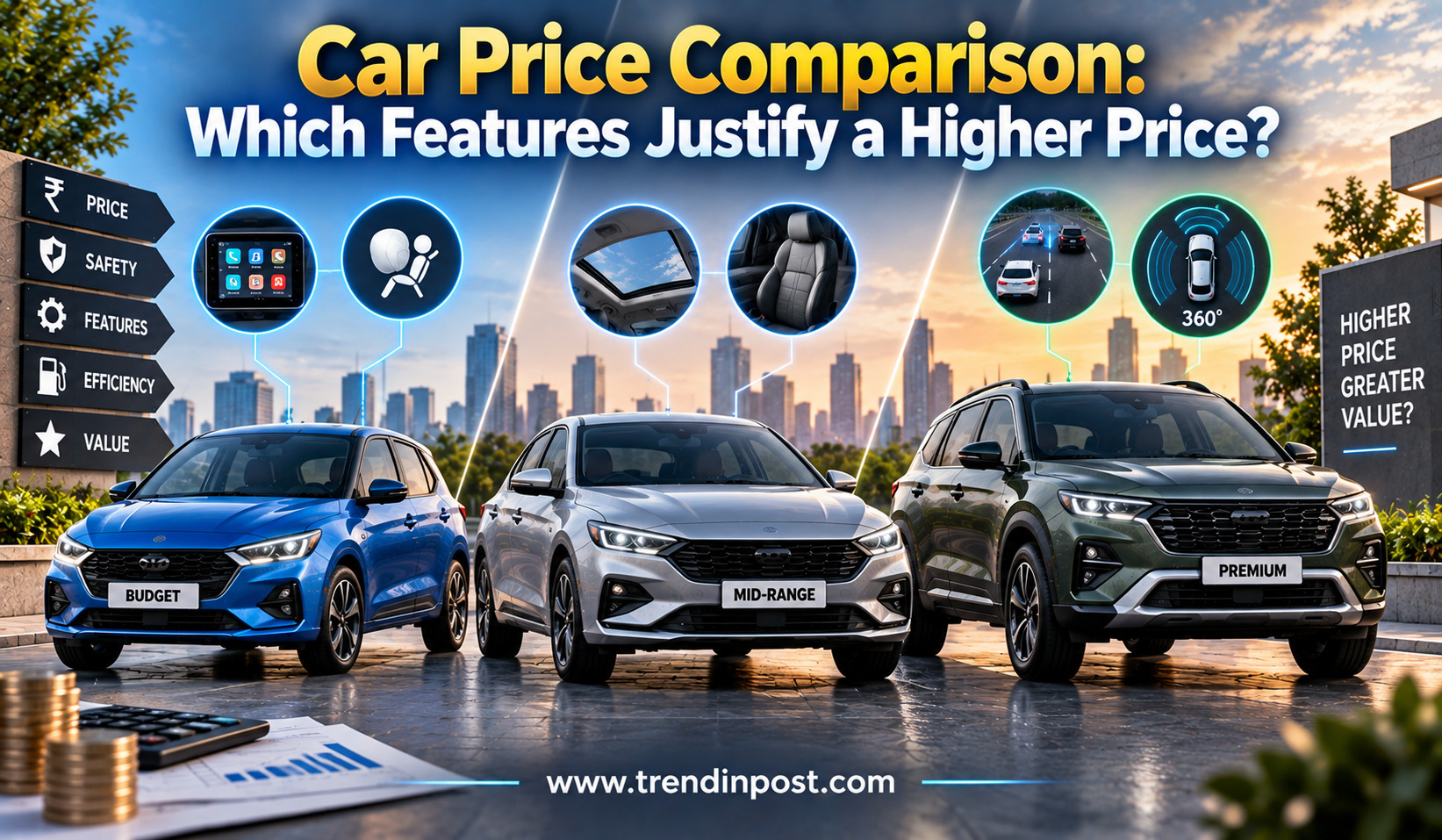
Car Price Comparison: Which Features Justify a Higher Price?
Buying a new car is no longer simply a choice between a basic model and a fully loaded version. Automakers now offer several variants of the same vehicle, with noticeable differences in price and equipment. A lower variant may provide the essentials, while a higher version can add better safety technology, larger screens, premium interiors, advanced comfort features and driver assistance systems.
This creates an important question for buyers: Which features actually justify paying more?
A higher-priced car or variant can offer meaningful benefits, but a longer equipment list does not automatically make it better value. Some features can improve safety or everyday convenience, while others are mainly designed to enhance appearance or provide additional luxury.
The right comparison therefore involves looking beyond the price difference. Buyers should consider how often a feature will be used, whether it improves safety or comfort, and whether the additional cost makes sense over several years of ownership.
Start With the Actual Price Difference
The first step in comparing two car variants is to calculate the real price gap. Buyers should compare the on-road prices rather than relying only on advertised ex-showroom prices.
A higher variant may cost substantially more once registration, insurance and other charges are included. The additional amount should then be compared with the features gained.
For example, if the more expensive variant adds several safety and convenience features for a relatively modest increase, the upgrade may make sense. If most of the extra cost goes toward cosmetic additions that the buyer does not particularly value, the lower variant could offer better value.
Safety Features Usually Deserve Higher Priority
When spending extra on a car, safety-related equipment should generally be near the top of the priority list. Features such as electronic stability control, additional airbags, ABS, traction control, parking sensors and cameras can provide practical benefits.
Modern cars are also increasingly available with advanced driver-assistance systems. Depending on the model, these can include forward collision warning, autonomous emergency braking, lane departure warning and adaptive cruise control.
However, buyers should not judge safety solely by counting features. Vehicle construction, independent crash-test performance and the availability of essential safety systems across variants should also be considered.
A higher variant that provides meaningful improvements in occupant protection or driver assistance can justify a price premium more easily than one that mainly adds styling features.
Parking Technology Can Be Worth Paying More For
Parking sensors and rear-view cameras have become increasingly important as vehicles grow larger. A camera provides a visual view behind the car, while sensors can alert the driver when approaching an obstacle.
A 360-degree camera system can provide an even wider perspective around the vehicle on selected models. For drivers who regularly park in narrow apartment spaces, crowded urban areas or busy shopping centres, such technology can offer genuine everyday value.
The usefulness of these features is particularly noticeable in SUVs, where the larger dimensions can make rear visibility more difficult.
Comfort Features Can Justify a Moderate Upgrade
Comfort equipment is another area where spending more can make sense. Automatic climate control, better seats, rear air-conditioning vents, adjustable rear seats and improved cabin materials can make daily travel more pleasant.
For people who spend several hours commuting every day, these features can provide value throughout the ownership period.
However, comfort features should be judged according to actual usage. A buyer who mostly drives short distances may not gain enough benefit from expensive cabin upgrades to justify a large price increase.
Infotainment Should Be Judged by Functionality
Large touchscreen displays have become a major selling point for modern cars. But a bigger screen does not necessarily mean a better infotainment experience.
Buyers should consider smartphone connectivity, navigation, audio quality, responsiveness, voice controls and ease of operation. A smaller but reliable system can sometimes be more useful than a larger display with complicated software.
Wireless Android Auto or Apple CarPlay, where available, can also be valuable for drivers who regularly use their smartphones for navigation and entertainment.
The key is to pay for useful functionality rather than screen size alone.
Driver Assistance Can Add Real Value for Highway Users
Advanced driver-assistance features are becoming more common in mainstream vehicles. Their usefulness depends heavily on where and how a car is driven.
For someone who regularly travels on highways, adaptive cruise control and lane-related assistance can reduce some of the effort involved in long-distance driving. Collision warning and emergency braking systems may also provide an additional layer of assistance.
For buyers who spend almost all their time in slow-moving urban traffic, however, paying a substantial premium for highway-focused assistance may not make as much sense.
ADAS should therefore be considered according to driving habits rather than treated as a must-have feature for everyone.
Automatic Climate Control vs Other Comfort Features
Automatic climate control is an example of a feature that can be genuinely useful without dramatically changing the character of a car.
It allows the driver to select a preferred temperature while the system manages cabin cooling. In hot climates and during long commutes, this can be more convenient than repeatedly adjusting manual controls.
Still, if choosing between automatic climate control and a significantly more expensive cosmetic package, buyers should consider which feature will actually be used more frequently.
LED Lighting Can Be a Practical Upgrade
LED headlights and other LED lighting elements are now available on a wide range of vehicles. While they contribute to a car’s appearance, lighting performance is the more important consideration.
Drivers who frequently travel at night may find a well-designed lighting system particularly useful. Buyers should look at the actual headlamp performance rather than choosing a vehicle solely because the lights use LED technology.
Lighting upgrades can be worthwhile when they provide better visibility, but decorative lighting elements should not be given the same priority.
Sunroof: Premium Appeal or Real Value?
Sunroofs have become popular in many mainstream cars, particularly SUVs. They can make the cabin feel more open and add to the vehicle’s visual appeal.
However, a sunroof is usually a lifestyle feature rather than an essential piece of equipment. If moving to a higher variant requires paying a significant premium mainly to get a sunroof, buyers should decide whether they will actually use it.
For some customers, the feature is an important part of the ownership experience. For others, the same money could provide more practical equipment elsewhere.
Connected Technology Is Useful for Some Buyers
Connected-car systems can provide smartphone-based access to vehicle information and certain remote functions. Depending on the manufacturer, these systems may include service reminders, vehicle status information, location-related features and emergency assistance.
The value of connected technology depends on how frequently the owner uses these functions. Buyers should also check whether certain services require a subscription after an initial period.
If the system is regularly used, it can justify a small premium. If it is likely to be ignored, it should not be a major reason for selecting a more expensive variant.
Features That Can Justify a Higher Price
| Feature | Potential value | Why it may justify extra cost |
| Additional safety equipment | Very high | Can improve protection and driver assistance |
| Rear camera and sensors | High | Makes parking and reversing easier |
| Automatic climate control | High | Improves everyday cabin convenience |
| Smartphone connectivity | High | Useful for navigation and entertainment |
| LED headlights | Medium to high | Useful for frequent night driving |
| ADAS | Medium to high | Helpful for suitable highway driving |
| Connected-car technology | Medium | Convenient for certain owners |
| Sunroof | Personal preference | Mainly improves cabin experience |
| Larger alloy wheels | Low to medium | Primarily appearance-oriented |
| Larger touchscreen | Medium | Useful when functionality also improves |
Don’t Ignore Long-Term Ownership Costs
A feature may seem attractive at the showroom but create additional costs later. Larger wheels, for example, may require more expensive tyres. More sophisticated electronic equipment could potentially be more costly to repair outside warranty.
This does not mean buyers should avoid advanced features. Instead, the complete ownership picture should be considered.
The additional purchase price, financing cost, insurance, maintenance and replacement expenses should all be part of the comparison.
Mid-Range Variants Often Offer the Best Balance
The highest variant is not automatically the best choice. In many cases, a mid-range version may contain the safety and convenience equipment that most buyers actually need while avoiding expensive cosmetic additions.
This is why comparing variants feature by feature can be more useful than simply comparing their names.
A buyer may discover that the lower variant already includes essential safety equipment and smartphone connectivity, while the top version mainly adds a sunroof, larger wheels and cosmetic upgrades. In such a situation, spending more may not provide enough practical benefit.
Match Features With Your Driving Lifestyle
A car feature becomes more valuable when it solves a real problem for the owner.
City drivers may benefit from parking cameras, compact dimensions, good visibility and automatic climate control. Highway users may place greater importance on comfortable seats, cruise control, strong lighting and driver assistance.
Families may prioritise rear-seat comfort, additional safety equipment and useful storage. Buyers who rarely drive may prefer to avoid paying extra for technology they will seldom use.
The best value therefore varies from one buyer to another.
Final Thoughts
Comparing car prices should involve much more than looking at the difference between two variants. Buyers should examine exactly what they receive for the additional money and determine whether those features will provide meaningful value throughout ownership.
Safety technology, parking assistance, useful comfort features and practical connectivity are often easier to justify than purely cosmetic upgrades. Advanced driver assistance can also be worthwhile for drivers who regularly travel on highways.
Features such as sunroofs, larger wheels and oversized displays can still be desirable, but their value is largely dependent on personal preference.
The smartest purchase is usually not the cheapest car or the most expensive variant. It is the version that provides the right combination of safety, comfort, technology and practicality without making the buyer pay heavily for features they are unlikely to use.
FAQs
Which car features are usually worth paying extra for?
Safety equipment, parking cameras and sensors, useful climate-control features, smartphone connectivity and suitable driver-assistance systems can offer strong value depending on the buyer’s requirements.
Is the top variant always the best value?
No. A mid-range variant can sometimes provide the most important equipment at a considerably lower price.
Should I pay extra for a sunroof?
A sunroof is mainly a comfort and lifestyle feature. It can be worthwhile if you value it, but essential safety equipment should generally take priority.
Is ADAS worth the additional cost?
It can be useful for drivers who regularly travel on highways. Buyers should understand the system’s capabilities and limitations before paying extra.
Is a bigger infotainment screen worth upgrading for?
Not necessarily. Buyers should focus on functionality, smartphone integration and ease of use rather than screen size alone.
Related Post
Car Safety Features Worth Paying More for in 2026
Car buyers in 2026 have more safety technology to choose from than ever before. Even…