Cars With Large Boot Space for Family Travel and Airport Runs
>> Automobile>> Cars With Large Boot Space for Family Travel and Airport Runs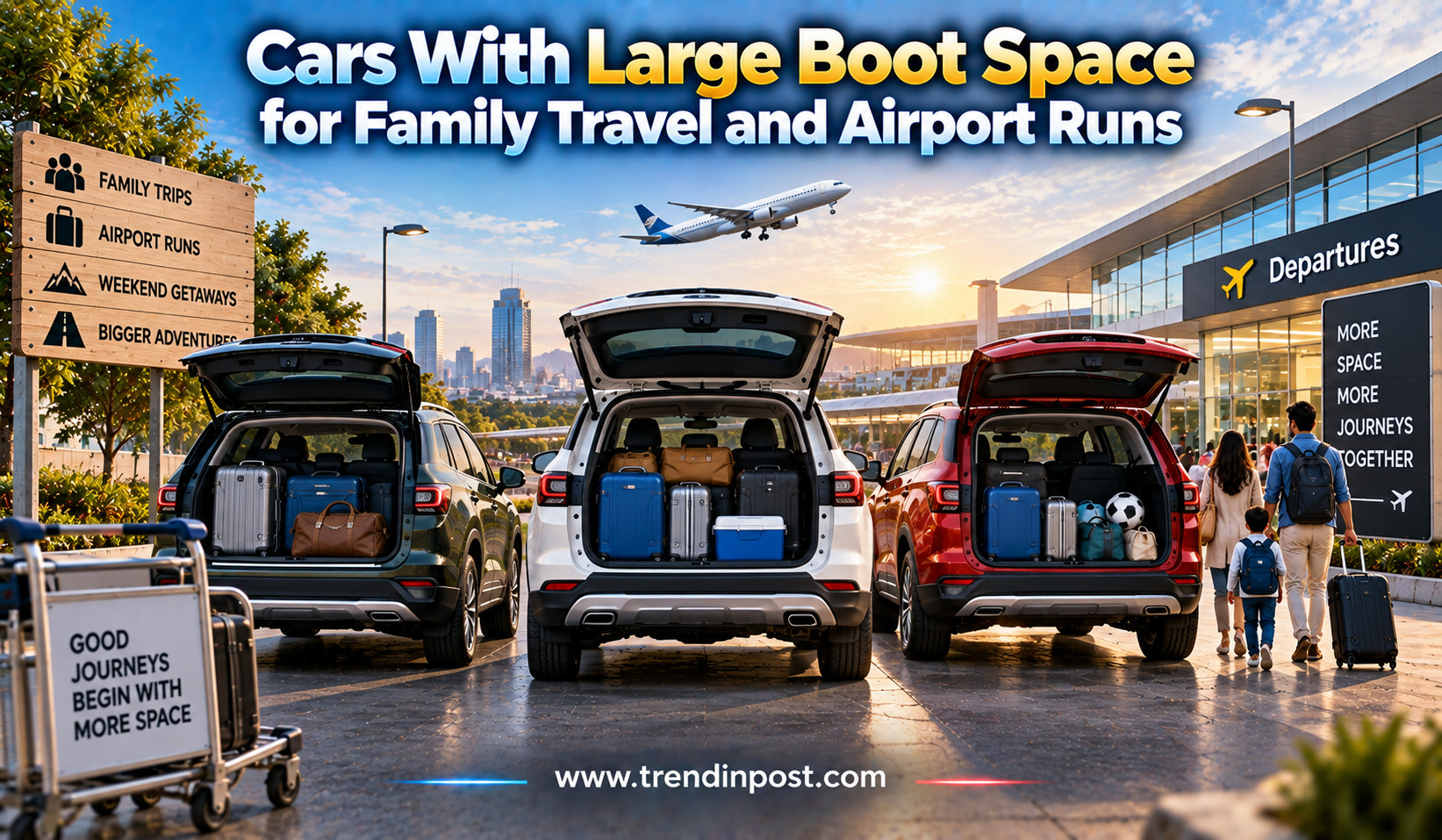
Cars With Large Boot Space for Family Travel and Airport Runs
For families, buying a car is rarely just about engine performance, styling or the latest technology. Everyday practicality can matter much more, especially when the vehicle is regularly used for family holidays, weekend trips and airport transfers. One of the most useful features in such situations is generous boot space.
A car with a large boot can make travelling considerably easier. Suitcases, backpacks, shopping bags, children’s luggage and other travel essentials can quickly fill a small luggage area. This becomes even more challenging when four or five passengers are travelling together. For airport runs in particular, luggage capacity can determine whether everything fits comfortably without blocking the passenger area.
The Indian market now offers a wide range of cars with practical luggage compartments, from hatchbacks and sedans to compact SUVs, midsize SUVs and MPVs. However, the largest boot figure on paper does not always mean the vehicle will be the most convenient family car. Boot shape, loading height, rear-seat flexibility and overall cabin space can be equally important.
Why Boot Space Matters for Family Travel
Family travel usually involves more luggage than a normal daily commute. A short weekend trip might require several bags, while a longer holiday can add suitcases, backpacks, children’s items and other equipment. A spacious boot gives passengers the freedom to carry these items without compromising seating comfort.
Airport journeys create a similar requirement. A family travelling with multiple suitcases needs enough room to load luggage safely while keeping all passengers seated comfortably. Trying to squeeze bags into the cabin can make the journey uncomfortable and may also interfere with visibility.
A well-designed boot therefore contributes to the overall practicality of a vehicle. It is not simply a number quoted in litres; it is about how easily the available space can be used.
Sedans Can Still Offer Impressive Luggage Space
Although SUVs have become increasingly popular, sedans should not be overlooked by buyers who prioritise boot capacity. Their separate luggage compartments can provide substantial storage space, particularly for suitcases and rectangular bags.
The lower boot floor found in many sedans can also make it relatively easy to arrange luggage. However, the opening may be narrower than that of an SUV or hatchback, which can make loading bulky objects more difficult.
For families primarily carrying suitcases, bags and everyday luggage rather than large household items, a sedan can therefore be a highly practical choice.
SUVs Combine Boot Space With Flexibility
SUVs have become popular with family buyers because they combine luggage capacity with a spacious cabin and higher seating position. Many midsize SUVs provide enough boot space for regular family use while still offering comfortable seating for five occupants.
Another advantage is the shape of the luggage area. The larger rear opening found on many SUVs makes loading tall or bulky objects easier. Foldable rear seats can further increase carrying capacity when the vehicle is not being used to transport the maximum number of passengers.
However, SUV boot space varies significantly between models. Buyers should examine the actual layout instead of assuming that every SUV has a large luggage compartment.
MPVs Are Designed Around Family Practicality
For larger families, MPVs can offer an even more useful combination of passenger and luggage flexibility. Their cabin layouts are designed to accommodate multiple occupants, while some models provide flexible seating arrangements.
The challenge is that when all three rows are occupied, luggage space behind the third row can become limited in certain MPVs. Buyers should therefore check the boot capacity with all seats in use rather than looking only at the maximum luggage capacity with seats folded.
For airport transfers involving six or seven passengers, this distinction becomes especially important.
Boot Space for Airport Runs
Airport travel places specific demands on a car. Suitcases are generally larger and heavier than the bags carried during daily commuting. A family may also have multiple cabin bags that need to be stored securely.
A good airport-run vehicle should ideally offer a wide luggage opening, a reasonably low loading height and enough depth to accommodate suitcases without forcing them into the passenger area.
Another useful feature is a flexible rear seat. If only two or three passengers are travelling, folding part of the rear seat can create additional luggage space. For families travelling with a full passenger load, however, the normal boot capacity becomes much more important.
What Makes a Boot Practically Useful?
Boot volume is an important specification, but it does not tell the entire story. Two cars with similar quoted capacities can feel very different when luggage is actually loaded.
The shape of the boot is one major factor. A square and well-organised luggage area can accommodate suitcases more efficiently than a deep but narrow compartment. The height of the loading lip also matters because heavy bags are easier to lift into a lower boot.
Buyers should also examine whether the rear wheel arches intrude into the luggage area, whether the rear seats fold flat and whether there are useful hooks or compartments for smaller items.
For regular family travel, these seemingly small details can make a noticeable difference.
Cars With Large Boot Space: What Buyers Should Consider
| Vehicle Type | Family Use | Airport Luggage | Flexibility | Best Suited For |
| Hatchback | Good for small families | Moderate | Good | City and short trips |
| Sedan | Very good | Very good for suitcases | Moderate | Families and highway travel |
| Compact SUV | Very good | Good to very good | Good | Mixed city and travel use |
| Midsize SUV | Excellent | Excellent | Very good | Frequent family trips |
| MPV | Excellent for larger families | Depends on third-row use | Excellent | Large families and group travel |
How Many Passengers Change the Equation
The amount of available luggage space depends heavily on the number of passengers. A five-seat car may offer a generous boot when fully occupied, but adding a third-row arrangement can change the equation considerably.
For a family of four, many midsize SUVs and sedans can provide a useful balance between passenger comfort and luggage capacity. A family of six or seven may need an MPV, but should check the luggage area behind the last row carefully.
This is particularly relevant for airport journeys. A vehicle that comfortably carries seven people may not necessarily carry seven people plus several large suitcases without using additional luggage solutions.
Foldable Seats Add Versatility
Rear-seat flexibility can transform a car’s luggage-carrying ability. A 60:40 split-folding rear bench, for example, can allow passengers to retain one or two seating positions while creating additional space for luggage.
This is useful for families because not every journey requires maximum passenger capacity. A weekend shopping trip, home improvement run or holiday involving fewer passengers can benefit greatly from additional cargo room.
However, buyers should check how easily the seats fold and whether the resulting floor is reasonably flat. A complicated seat-folding mechanism can reduce the practical benefit.
Features That Make Loading Easier
A large boot becomes even more useful when the car has features that make loading and unloading convenient. Buyers should look for:
- A wide and practical tailgate opening.
- A low or manageable loading height.
- Rear seats that fold easily.
- Luggage hooks, covers or storage compartments.
A powered tailgate can be particularly convenient for people frequently loading heavy luggage, although it is not essential for a practical family car.
Boot Space vs Overall Cabin Space
It is easy to focus entirely on boot capacity, but family travel requires a balance between luggage and passenger comfort. A car with a huge boot but cramped rear seats may not be ideal for long journeys.
Rear-seat legroom, headroom and seat cushioning can become just as important when travelling several hundred kilometres. Families should also consider the amount of space available for smaller personal items inside the cabin.
Door pockets, centre-console storage and seat-back pockets can help keep the passenger compartment organised while larger luggage remains in the boot.
What Should Families Check During a Test Drive?
A test drive should include more than checking the driving position. If luggage capacity is a priority, buyers should physically inspect the boot.
Take a suitcase or estimate the size of the family’s usual travel bags and see how they fit. Check whether two or three large suitcases can be placed without leaving awkward gaps. Families should also sit in the rear seats while the boot is loaded to ensure passenger comfort is not compromised.
For buyers considering an MPV, checking the boot with every row occupied is particularly important.
Large Boot Space Is Useful Beyond Holidays
A spacious boot is not only useful for vacations and airport transfers. It can improve everyday ownership as well. Grocery shopping, large packages, sports equipment, office bags and other household items can all benefit from additional luggage capacity.
This is one reason why practical cars often remain attractive even when buyers are also interested in technology and styling. A feature that is used almost every week can have a greater impact on ownership satisfaction than a feature used only occasionally.
Choosing the Right Car for Family Travel
The ideal vehicle depends on family size and travel habits. A small family that mainly travels within the city may find a sedan or compact SUV perfectly adequate. Buyers who frequently travel with four or five people and several suitcases may prefer a midsize SUV with a spacious luggage area.
Larger families should consider MPVs and examine their luggage capacity with all seats occupied. The important point is to match the car’s actual configuration with the way it will be used.
Buyers should also remember that boot space can vary between different variants of the same model, particularly when spare-wheel arrangements, hybrid components or other mechanical hardware occupy luggage-area space.
Final Thoughts
Large boot space can make a significant difference to family car ownership. Whether the vehicle is being used for a weekend holiday, a long highway journey or an airport drop, generous and well-designed luggage space reduces the need to compromise on passenger comfort.
Sedans continue to offer useful boot capacity, while SUVs provide a combination of luggage room, cabin space and flexible seating. MPVs can be particularly valuable for larger families, although buyers need to check luggage capacity when all seats are occupied.
Ultimately, the best family car is not necessarily the one with the biggest number in its specifications sheet. A practical boot opening, useful shape, flexible seats and comfortable passenger cabin can be equally important. Buyers who test these factors with their own luggage before making a purchase are more likely to find a vehicle that works well for everyday family travel.
FAQs
How much boot space is enough for a family?
The answer depends on family size and travel habits. A small family may be comfortable with a moderately sized boot, while families travelling with several large suitcases should consider a sedan, midsize SUV or MPV with greater luggage capacity.
Are SUVs better than sedans for luggage?
Not necessarily. Many sedans offer excellent boot volume for suitcases. SUVs can have an advantage when carrying bulky objects because their larger rear openings and flexible seating can make loading easier.
Are MPVs good for airport travel?
Yes, especially for larger groups. However, buyers should check how much luggage space remains when all passenger seats are occupied.
Is boot volume measured in litres enough to judge practicality?
No. The shape of the boot, opening size, loading height and seat-folding arrangement can make a major difference to how useful the space feels.
Does folding the rear seat increase boot space?
Yes. Folding rear seats can substantially increase the available cargo area. Split-folding seats are particularly useful because they allow passengers to retain some rear seating while carrying longer or larger items.
Related Post

Car Price Comparison: Which Features Justify a Higher Price?
Buying a new car is no longer simply a choice between a basic model and…