BMW Motorrad Vision CE: Could the Self-Balancing Electric Scooter Reach India?
>> Automobile>> BMW Motorrad Vision CE: Could the Self-Balancing Electric Scooter Reach India?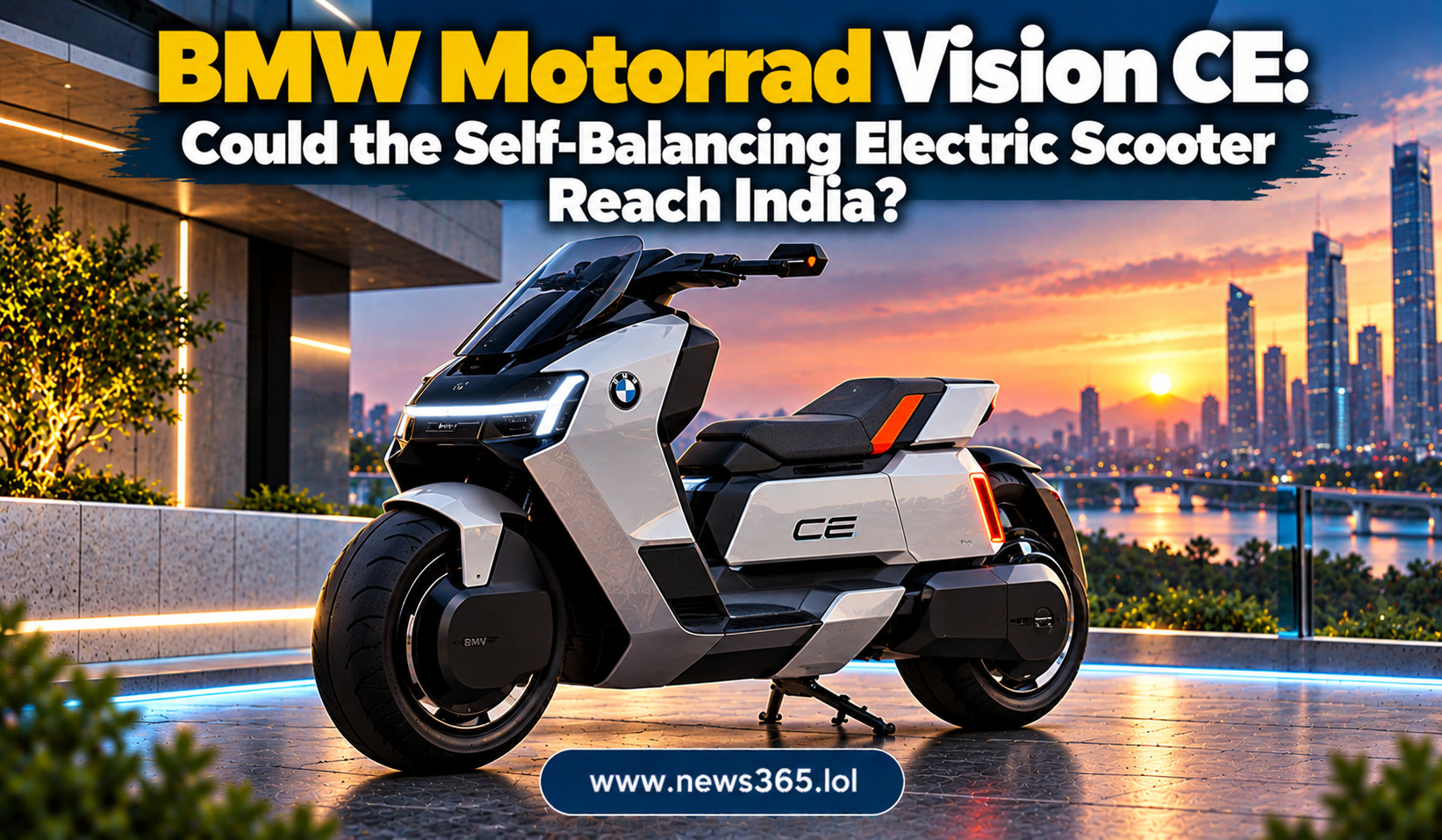
BMW Motorrad Vision CE: Could the Self-Balancing Electric Scooter Reach India?
The electric two-wheeler market is evolving beyond conventional scooters, with manufacturers exploring new designs, safety technologies and intelligent riding systems. One of the most unusual concepts attracting attention is the BMW Motorrad Vision CE, an electric scooter designed to balance itself when stationary and surround the rider with a protective structure.
The concept has gained fresh attention in India after reports of a design patent filing by BMW Motorrad. Its distinctive appearance, self-balancing capability and unusual safety-focused design have raised an important question: could this futuristic electric scooter eventually become available to Indian buyers?
Although the Indian patent development is encouraging for enthusiasts, BMW has not confirmed a production version or an India launch. Here’s what we know about the Vision CE, its technology, design and potential Indian market prospects.
BMW Motorrad Vision CE: What Is This Electric Scooter?
The BMW Motorrad Vision CE is an electric urban mobility concept developed by BMW Motorrad. It was presented at the IAA Mobility 2025 event in Germany as a possible direction for future electric two-wheelers.
Unlike conventional electric scooters, the Vision CE combines an open-sided protective cage with a distinctive seating arrangement and self-balancing technology. Its design attempts to rethink how riders experience everyday urban transportation.
The concept also draws inspiration from the BMW C1, an unusual scooter introduced around 25 years earlier. The C1 used a protective structure and seatbelt arrangement to provide an alternative approach to rider safety.
With the Vision CE, BMW revisits this idea using a more modern design, electric propulsion and advanced technology. Its long wheelbase, low profile and open tubular structure give it an appearance that is very different from traditional scooters.
BMW describes the Vision CE as a concept rather than a confirmed production model. Therefore, its design and technology should be understood as a preview of possible future mobility solutions.
BMW Vision CE India Patent: What Has Happened?
The latest development came in October 2026, when reports confirmed that BMW Motorrad had filed a design patent for the Vision CE in India.
The filing has attracted attention because it suggests that BMW is protecting the concept’s distinctive design in the Indian market. It also indicates that the company is considering how its innovative electric mobility ideas could relate to markets beyond its initial global presentation.
However, a design patent does not automatically mean a vehicle will enter production or become available for purchase.
Automotive manufacturers regularly register designs and intellectual property in multiple countries to protect their innovations. Such filings can happen well before a commercial launch, and some patented concepts never reach dealerships.
As of October 30, 2026, BMW Motorrad has not announced an Indian launch date, confirmed production plans or an India-specific price for the Vision CE.
For now, the patent is an interesting development rather than confirmation of an upcoming electric scooter launch.
Self-Balancing Technology: The Vision CE’s Biggest Attraction
The most distinctive feature of the BMW Vision CE is its self-balancing capability.
The concept is designed to remain upright on its two wheels even when stationary. This means the rider would not need to put their feet on the ground at every traffic signal or depend on a conventional stand while the system is active.
Such technology could make urban riding more convenient, especially for people who find it difficult to balance heavier two-wheelers at low speeds.
In everyday situations, self-balancing technology could potentially help with stopping in traffic, waiting at junctions and manoeuvring through congested areas. It could also make the scooter more approachable for some riders who are uncomfortable handling conventional motorcycles.
However, BMW has not published complete technical details explaining the system’s operating limits, hardware configuration or behaviour in different riding conditions.
It would therefore be premature to assume that the technology will eliminate every balancing challenge or require no rider input in a future production model.
Protective Cage and Seatbelt: A Different Approach to Rider Safety
Another major highlight of the Vision CE is its protective cage.
The concept uses a metal tubular structure around the rider, with an integrated seat and seatbelt arrangement. BMW’s design philosophy is to provide additional physical protection instead of relying entirely on conventional motorcycle riding equipment.
The structure is intended to protect different areas of the rider’s body. A front tubular frame offers protection around the feet and legs, while the surrounding cage is designed to provide additional lateral protection around the upper body.
The seating arrangement also includes a four-point restraint system. This is one of the reasons the Vision CE looks more like a futuristic personal mobility vehicle than a traditional electric scooter.
BMW’s concept presentation promotes a riding experience without a helmet or conventional protective clothing. However, this should not be interpreted as legal permission to ride helmet-free in India.
The concept’s protective structure has not been established as a replacement for legally required safety equipment on Indian roads. Any future production version would need to comply with applicable Indian vehicle and road-safety regulations.
Its real-world crash protection would also need to be assessed through appropriate engineering validation and testing.
Design and Expected Features
The Vision CE has a futuristic appearance with a long wheelbase, low seating position and open cage structure. Its design combines coated aluminium elements, a tubular frame and a minimalist black-and-white colour scheme with red accents.
The concept also features large 15-inch disc wheels and a stretched body profile. These elements give it a distinctive road presence while supporting its low-slung urban mobility design.
Unlike conventional scooters, the Vision CE is focused on a single-rider experience. Its unusual seating arrangement and protective structure are central to its overall design.
BMW has not released a complete production specification sheet. Details such as battery capacity, motor power, torque, top speed, charging time, kerb weight and riding range remain unconfirmed.
It is important not to use the technical specifications of the BMW CE 04 as if they belong to the Vision CE. Although both vehicles are part of BMW Motorrad’s electric mobility portfolio, the company has not confirmed that the concept will use the same battery or powertrain.
Could BMW Vision CE Launch in India?
The Indian design patent has increased interest in a possible launch, but several steps would need to happen before the Vision CE becomes a commercially available scooter.
BMW would first need to decide whether the concept is suitable for production. This would involve evaluating the self-balancing system, protective cage, restraint arrangement, manufacturing costs and compliance with vehicle regulations.
The company would also need to consider how the unusual design fits Indian commuting conditions. Narrow roads, dense traffic, parking availability and different rider preferences could influence the practicality of the concept.
Another important consideration is price. BMW Motorrad operates in the premium motorcycle segment in India, and an advanced electric scooter featuring specialised safety technology could be positioned above conventional electric scooters.
However, there is currently no official pricing information or confirmed production schedule.
The Vision CE should therefore be treated as a possible future product rather than an electric scooter that Indian customers can expect to purchase within a specific timeframe.
What Could Be Its Expected Price in India?
BMW has not announced an expected price for the Vision CE, so any specific figure would be speculative.
One useful reference point is the BMW CE 04, which is already available in India at an ex-showroom price of approximately ₹15.25 lakh. It offers a premium electric scooter experience with an 8.5kWh battery, 42hp motor and claimed WMTC range of 130km.
However, these are CE 04 specifications, not Vision CE specifications.
If the Vision CE eventually enters production, its price will depend on the final battery technology, self-balancing hardware, protective structure, safety equipment and level of localisation.
Its unusual engineering could make it an expensive product compared with mainstream electric scooters from brands such as Ather, TVS, Bajaj and Ola.
Until BMW announces a production model, it is better to avoid publishing an estimated launch price as though it were confirmed.
What the BMW Vision CE Could Mean for India’s EV Market
The Vision CE represents a different way of thinking about electric two-wheelers. Most electric scooters compete through battery range, charging speed, connected features and purchase price.
BMW’s concept introduces another area of innovation: how technology and vehicle structure could change the riding experience.
Self-balancing systems could eventually become useful in premium urban mobility products, particularly for riders who want additional assistance at low speeds. Protective structures could also encourage manufacturers to explore alternative safety concepts.
However, making these technologies affordable, reliable and suitable for Indian traffic conditions would be a significant challenge.
For BMW, the concept provides an opportunity to demonstrate its approach to future electric mobility. For Indian customers, it offers a glimpse of how premium electric two-wheelers could evolve beyond conventional scooter designs.
Final Outlook: Will the BMW Vision CE Reach Indian Showrooms?
The BMW Motorrad Vision CE is one of the more unusual electric two-wheeler concepts to attract attention in India. Its self-balancing technology, protective cage and integrated seatbelt make it different from conventional electric scooters.
The reported Indian design patent filing in October 2026 has added to the possibility of future market interest. However, it does not confirm that BMW will manufacture or launch the Vision CE in India.
The next important developments would be an official production announcement, technical specifications and a clear decision about international availability.
Until then, Indian buyers should view the Vision CE as an innovative concept worth following rather than an upcoming showroom product with a confirmed launch schedule.
Related Post

Cars With Large Boot Space for Family Travel and Airport Runs
For families, buying a car is rarely just about engine performance, styling or the latest…