
Ather Rizta vs TVS iQube: Which Family Electric Scooter Is Better?
>> Automobile>> Ather Rizta vs TVS iQube: Which Family Electric Scooter Is Better?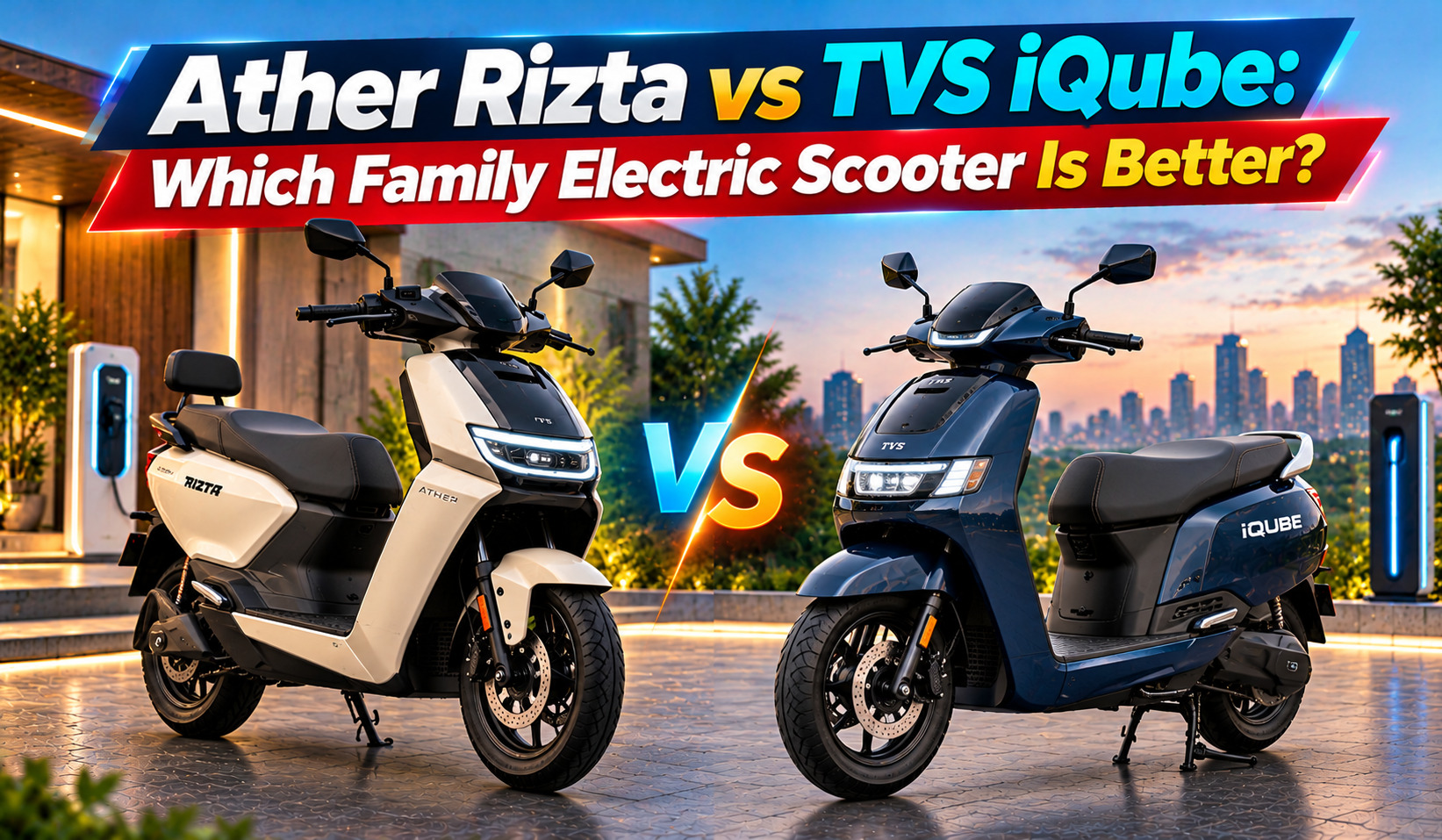
Ather Rizta vs TVS iQube: Which Family Electric Scooter Is Better?
Electric scooters are becoming a practical option for Indian families looking to reduce daily commuting expenses without compromising convenience. Among the popular choices in this category, the Ather Rizta and TVS iQube stand out for their family-friendly designs, comfortable riding experience and connected features. Both scooters are designed for everyday city travel, but they approach practicality in slightly different ways.
The Ather Rizta focuses strongly on family comfort, storage and rider-assistance technology, while the TVS iQube offers multiple battery configurations and a choice of range options. So, which one should you choose? Let’s compare their prices, battery capacity, claimed range, charging, features and everyday usability.
Ather Rizta vs TVS iQube: Price in India
Price is an important consideration when purchasing an electric scooter for family use. Both manufacturers offer multiple variants, allowing buyers to select a configuration that matches their budget and commuting requirements.
The Ather Rizta is available in S and Z variants. Its official starting price is ₹1,21,999 for the Rizta S, while the Rizta Z starts at ₹1,36,999. The final price depends on the selected battery configuration, city, colour and applicable charges.
The TVS iQube offers a wider selection of battery options. Its lineup includes 2.3kWh, 3.1kWh and 3.5kWh versions, along with the iQube S 4.7kWh and iQube ST 5.3kWh. TVS displays effective ex-showroom prices starting at approximately ₹95,124, with higher-capacity variants costing more. These effective prices include applicable incentives and may differ depending on state benefits and eligibility.
For buyers with a limited budget, the entry-level TVS iQube can be an attractive starting point. However, comparing similarly equipped battery variants is more useful than looking only at the lowest advertised price.
Battery Capacity and Claimed Range
Battery capacity and range determine how conveniently an electric scooter can handle everyday travel. A family using its scooter for office commutes, shopping, school drop-offs and other short journeys should consider its expected daily distance rather than relying entirely on the highest advertised range.
The Ather Rizta offers multiple battery configurations, including 2.7kWh and larger-capacity options. Depending on the configuration, its claimed IDC range is 123km or 161km. This gives buyers the flexibility to select a version based on their commuting needs.
The TVS iQube provides an even broader range of battery choices. The 2.3kWh version offers a claimed IDC range of 114km, while the 3.1kWh model offers 123km. The 3.5kWh variant delivers 145km, the iQube S 4.7kWh offers 175km, and the top-end iQube ST 5.3kWh claims up to 212km.
On paper, the TVS iQube ST has the advantage when maximum claimed range is the priority. However, buyers should remember that IDC figures are laboratory-tested estimates. Actual range depends on riding speed, passenger weight, traffic, road conditions, temperature and riding mode.
For regular city commuting, both scooters offer configurations that can meet the requirements of many households. The right battery choice depends on how frequently the scooter will be used and how much distance the family covers each day.
Motor Performance and Everyday Riding
The Ather Rizta uses a permanent magnet synchronous motor with a peak power output of 4.3kW and maximum torque of 22Nm. Its claimed top speed is 80km/h, and it can accelerate from 0 to 40km/h in approximately 4.7 seconds.
The TVS iQube uses a hub-mounted electric motor with a peak output of 4.4kW in its higher-performance configurations. Most of the current lineup offers a claimed top speed of up to 82km/h, although the entry-level 2.3kWh variant has a lower top speed of 68km/h.
Both scooters are designed for urban conditions rather than high-speed touring. Their electric motors provide quick initial acceleration, which can be useful when navigating traffic and moving through busy city roads.
The Rizta’s performance figures make it suitable for everyday family travel, while the iQube offers a slightly higher top speed in most of its variants. However, the difference is unlikely to be the deciding factor for buyers who mainly travel within city limits.
Comfort, Storage and Family Practicality
Family comfort is one of the most important reasons buyers consider these two electric scooters. A practical family model should provide a comfortable seating arrangement, sufficient space for everyday belongings and manageable handling.
The Ather Rizta has a broad seat designed to accommodate both the rider and pillion comfortably. Its family-focused design also includes a pillion backrest, which can make longer city journeys more convenient for passengers. Its under-seat storage capacity is approximately 34 litres, providing useful space for helmets and daily essentials, depending on their size.
The TVS iQube also prioritises comfort with a spacious seat and a suspension setup intended for everyday roads. Selected versions offer up to 32 litres of under-seat storage, making it convenient for carrying groceries, bags and other belongings.
Both scooters are practical for family use, but the Rizta has a slight advantage in under-seat storage capacity. Buyers should still check whether their preferred helmets fit inside the storage compartment before making a purchase.
Technology and Safety Features
Modern electric scooters offer more than just battery-powered transportation. Connected features, navigation, safety assistance and digital displays can make everyday riding more convenient.
The Ather Rizta offers features such as an LCD or TFT display depending on the variant, smartphone connectivity and access to Ather’s connected ecosystem. Higher-spec versions include Google Maps navigation, Magic Twist, AutoHold, SkidControl and additional rider-assistance features. The exact feature list depends on the selected model.
The TVS iQube includes its SmartXonnect technology, which supports connected functions such as call and SMS alerts, navigation assistance, trip information, remote battery status and vehicle-related notifications. Higher variants offer larger displays, with the top-end ST receiving a touchscreen interface.
Both manufacturers also provide battery protection and connected ownership features. Ather’s higher variants stand out for their additional rider-assistance technologies, while TVS offers a useful range of connected functions across its lineup.
Before choosing, buyers should compare the exact equipment available on their preferred variants. Features listed for the top-end model may not be included in the entry-level version.
Charging Time and Ownership Convenience
Home charging is an important part of electric scooter ownership. Both Ather and TVS provide charging solutions designed for residential use, allowing owners to charge their scooters using compatible domestic electrical connections.
Ather offers home-charging support through its charging equipment, with charging time varying according to battery capacity and charger configuration. Its official Rizta specifications indicate that charging from 0 to 80% can take approximately six hours with the standard configuration or around three hours and 12 minutes with the faster charging setup.
TVS provides a portable charger for the iQube lineup. Its official specifications list different charging durations depending on battery size. For example, the 2.3kWh variant takes approximately two hours and 25 minutes for a 10–80% charge, while the 5.3kWh ST takes around four hours for the same charging range.
Charging figures should always be compared using the same starting and ending battery percentages. A larger battery may take longer to charge but can also provide a greater claimed range.
Both scooters can be suitable for households with access to regular home charging. Buyers should check the charger included with their chosen variant and confirm installation requirements before purchase.
Ather Rizta vs TVS iQube: Which One Should You Buy?
The Ather Rizta and TVS iQube serve a similar audience, but their strengths appeal to different types of buyers.
The Ather Rizta is worth considering if your priorities include family-oriented design, generous under-seat storage, a comfortable pillion experience and additional rider-assistance features on higher variants. Its 161km claimed IDC range configuration also provides a useful balance between battery capacity and everyday practicality.
The TVS iQube is a strong alternative for buyers who want more battery choices. Its lineup ranges from an affordable entry-level version to the long-range ST variant, which claims up to 212km of IDC range. Its connected features, familiar scooter design and wider dealer network are additional considerations for ownership.
Buyers comparing vehicles across different categories often look at how design, comfort and brand positioning influence purchasing decisions. A similar approach appears in discussions about the differences between Bentley and Rolls-Royce in the ultra-luxury car market, where the right choice depends on individual priorities rather than price or brand reputation alone. The same principle applies when selecting a family electric scooter.
Final Verdict
There is no single winner for every household. The Ather Rizta is a compelling option for families who value comfort, storage and additional technology. The TVS iQube makes sense for buyers who want a wider range of battery configurations and the option of a higher claimed range.
If family-friendly practicality is your main priority, the Rizta deserves a place on your shortlist. If you want more flexibility in battery capacity and maximum range, the TVS iQube ST is worth considering.
The best way to decide is to compare the on-road prices of your preferred variants, take a test ride with a pillion passenger and check the available service support in your city. That will help you choose an electric scooter that fits your family’s actual commuting needs.
Related Post

Why Maruti Suzuki Has a Strong Presence in the Indian Car Market
Maruti Suzuki has been one of the most familiar names in India's passenger vehicle market…