

How Water Resistance Works in Luxury Watches
>> LifeStyle>> How Water Resistance Works in Luxury Watches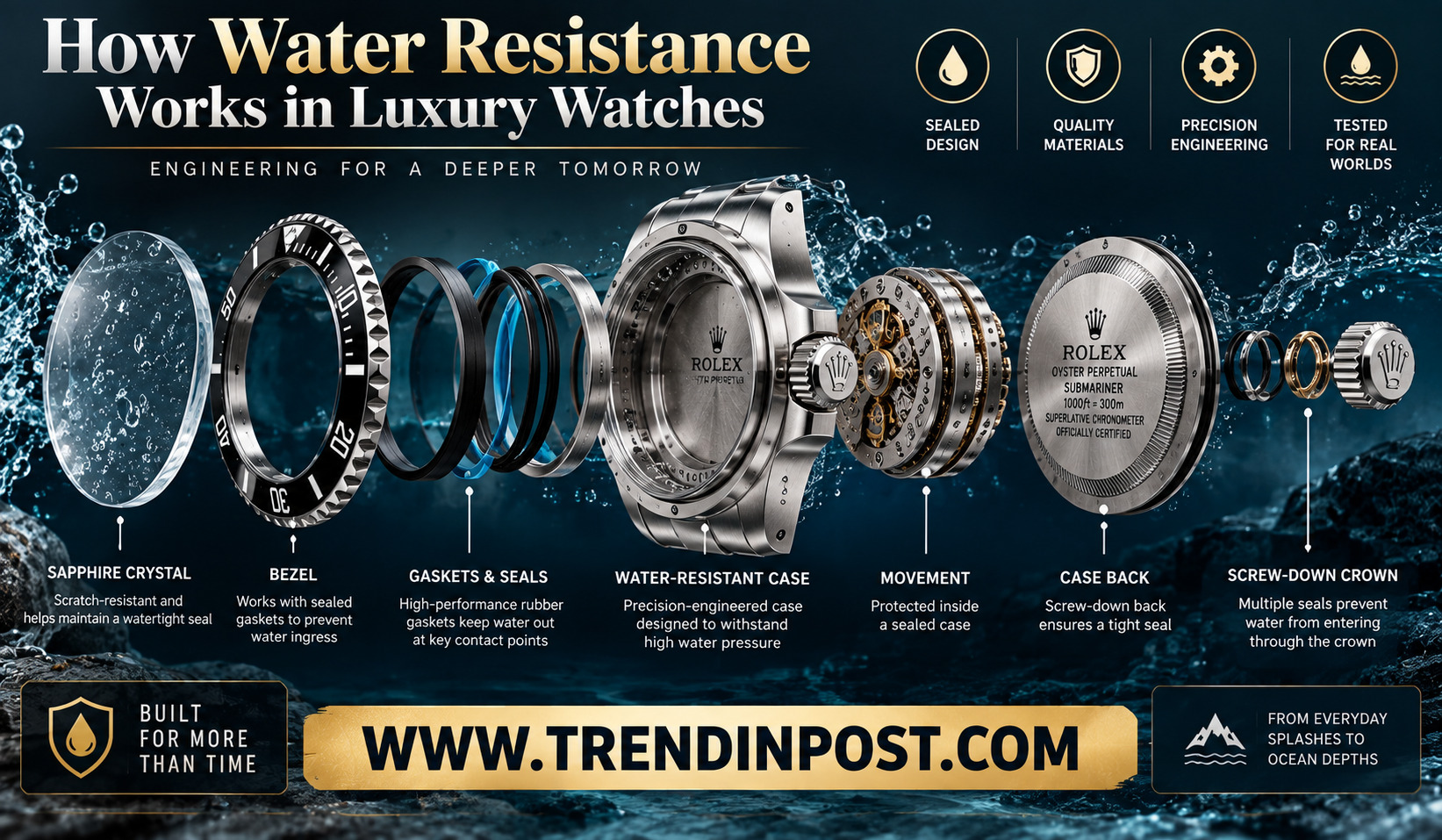
How Water Resistance Works in Luxury Watches
Introduction
A watch marked 100m water resistant was never actually built to survive 100 meters underwater. That single fact surprises most first-time buyers. Understanding how water resistance works in luxury watches means looking past the number stamped on the case back and into the physics, the parts, and the testing behind it. This guide breaks down what the ratings mean, which components do the actual work, and how to keep that protection intact for years.
What the Rating on Your Watch Actually Means
Water resistance shows up in three units: meters, ATM, and bar. All three describe the same underlying pressure. One ATM equals roughly 1.013 bar, and both correspond to about 10 meters of static water pressure. That means 10 ATM, 10 bar, and 100 meters all describe the identical level of protection.
Here is the part that trips people up. The meter figure is a pressure equivalent measured in a still lab tank, not a safe diving depth. A 30m rating covers splashes and rain. A 100m rating covers swimming and snorkeling, but not scuba diving. Motion, temperature changes, and impact all raise the real pressure a watch faces well above what a calm number on paper suggests.
The Parts That Keep Water Out
A watch case is not one solid block. It is several components joined together, and water resistance depends on every seal holding at once.
- Case back gasket: A rubber or silicone ring that seals the back of the case against the middle case.
- Crystal gasket: Seals the glass or sapphire crystal into the case.
- Crown gasket: Seals the stem where the crown meets the case, one of the most common failure points.
- Pusher gaskets: On chronographs, each pusher needs its own seal.
Each gasket loses flexibility over time. Heat, sunlight, and age dry out rubber gradually. A watch that was water resistant to 100 meters when new can lose much of that protection after several years without maintenance.
How Brands Test Water Resistance
Two ISO standards govern how a watch earns its water resistance claim, and they are not equal.
ISO 22810 covers ordinary water-resistant watches meant for daily wear and swimming. The test places the watch in a pressure chamber, applies static pressure matching the rated depth, and checks for leaks and condensation. Manufacturers can test a sample from a production batch rather than every single watch.
ISO 6425 covers certified divers’ watches and demands far more. It requires a minimum rating of 100 meters, testing at 125 percent of that rated pressure, a condensation check after thermal shock, and legibility requirements for use in darkness. Every single watch built to this standard must be tested individually, not just a sample.
This difference explains why only watches meeting ISO 6425 can print the word DIVER’S on the dial. A watch rated “200m water resistant” and one marked “DIVER’S 200m” are not making the same promise, even though the number matches.
Screw-Down Crowns and Why They Matter
The crown, the small knob used to set the time and wind the watch, is the single biggest weak point in any case design. A standard push-in crown relies on a gasket that sits under constant light pressure.
A screw-down crown threads into a sealed tube on the case, clamping the gasket much more tightly when locked. This design is standard on most watches rated 100 meters or higher. Leaving a screw-down crown unscrewed, even briefly, removes most of the watch’s water protection until it gets locked back down.
Why Real-World Use Differs From the Lab Test
The ISO 22810 test applies pressure slowly and evenly to a motionless watch. Real life does not work that way.
Diving into a pool, swimming laps, or even a hard tap on the crystal creates brief pressure spikes far above what the static number suggests. Hot showers followed by cold water can also stress gaskets through rapid temperature swings. This is why watch brands and repair shops routinely recommend leaving a wide safety margin between the printed rating and actual use.
A watch rated to 30 meters should stay dry outside of rain or hand washing. A watch rated to 100 or 200 meters handles swimming comfortably but still is not a diving tool unless it also carries ISO 6425 certification.
Keeping Water Resistance Intact Over Time
Water resistance is not permanent. Gaskets age, and case seals need periodic attention.
- Have gaskets inspected and replaced roughly every two to three years, sooner for watches used often in water.
- Ask for a pressure test after any service that opens the case.
- Rinse the case in fresh water after swimming in salt water or a chlorinated pool.
- Always check that a screw-down crown is fully locked before any water exposure.
- Avoid operating pushers or the crown while the watch is wet or submerged.
Following this routine keeps the original rating meaningful instead of theoretical.
Water Resistance Ratings at a Glance
| Rating | Equivalent | Suitable For |
| 30m (3 ATM) | 3 bar | Rain, splashes, hand washing |
| 50m (5 ATM) | 5 bar | Showering, light swimming |
| 100m (10 ATM) | 10 bar | Swimming, snorkeling |
| 200m (20 ATM) | 20 bar | Recreational scuba, if ISO 6425 certified |
| 300m+ (30+ ATM) | 30+ bar | Serious diving, professional dive watches |
Key Takeaways
- Units match: Meters, ATM, and bar all describe the same pressure, just in different scales.
- Rating is not depth: The printed number reflects a static lab test, not a safe real-world diving limit.
- Gaskets do the work: Case back, crystal, crown, and pusher gaskets all need to hold together for the rating to apply.
- Two standards, two promises: ISO 22810 covers everyday water resistance, while ISO 6425 is the stricter standard required for true dive watches.
- Maintenance matters: Gaskets age and need periodic replacement and pressure testing to keep the original rating valid.
FAQs
Can I swim with a watch rated 30 meters water resistant? No, a 30 meter rating only covers splashes and rain, not swimming or submersion.
What is the difference between ISO 22810 and ISO 6425? ISO 22810 covers everyday water-resistant watches tested on a sample basis, while ISO 6425 is the stricter standard for certified divers’ watches, requiring every watch to be individually tested.
Do I need to screw down the crown before swimming? Yes, an unscrewed crown removes most of the watch’s water resistance even if the case itself is rated highly.
How often should water resistance be tested? Most watchmakers recommend a gasket check and pressure test every two to three years.
Does a high water resistance rating mean a watch is safe for diving? Not automatically, since only watches certified to ISO 6425 and marked DIVER’S are built and tested for real diving use.
Conclusion
How water resistance works in luxury watches comes down to a mix of physics, engineering, and honest testing standards. The number on the case back describes a controlled lab result, not a lifetime guarantee or a diving certificate. Gaskets, screw-down crowns, and the right ISO standard all combine to determine what a watch can actually handle. Regular maintenance keeps that original protection real instead of theoretical, which matters far more than the size of the number printed on the dial.
Related Post

Can Everyday Fruits Compete With Trendy Superfoods?
Superfoods have become one of the most talked-about parts of modern food culture. From berries…