How Luxury EVs Are Reshaping Premium Car Choices in Europe
>> Automobile>> How Luxury EVs Are Reshaping Premium Car Choices in Europe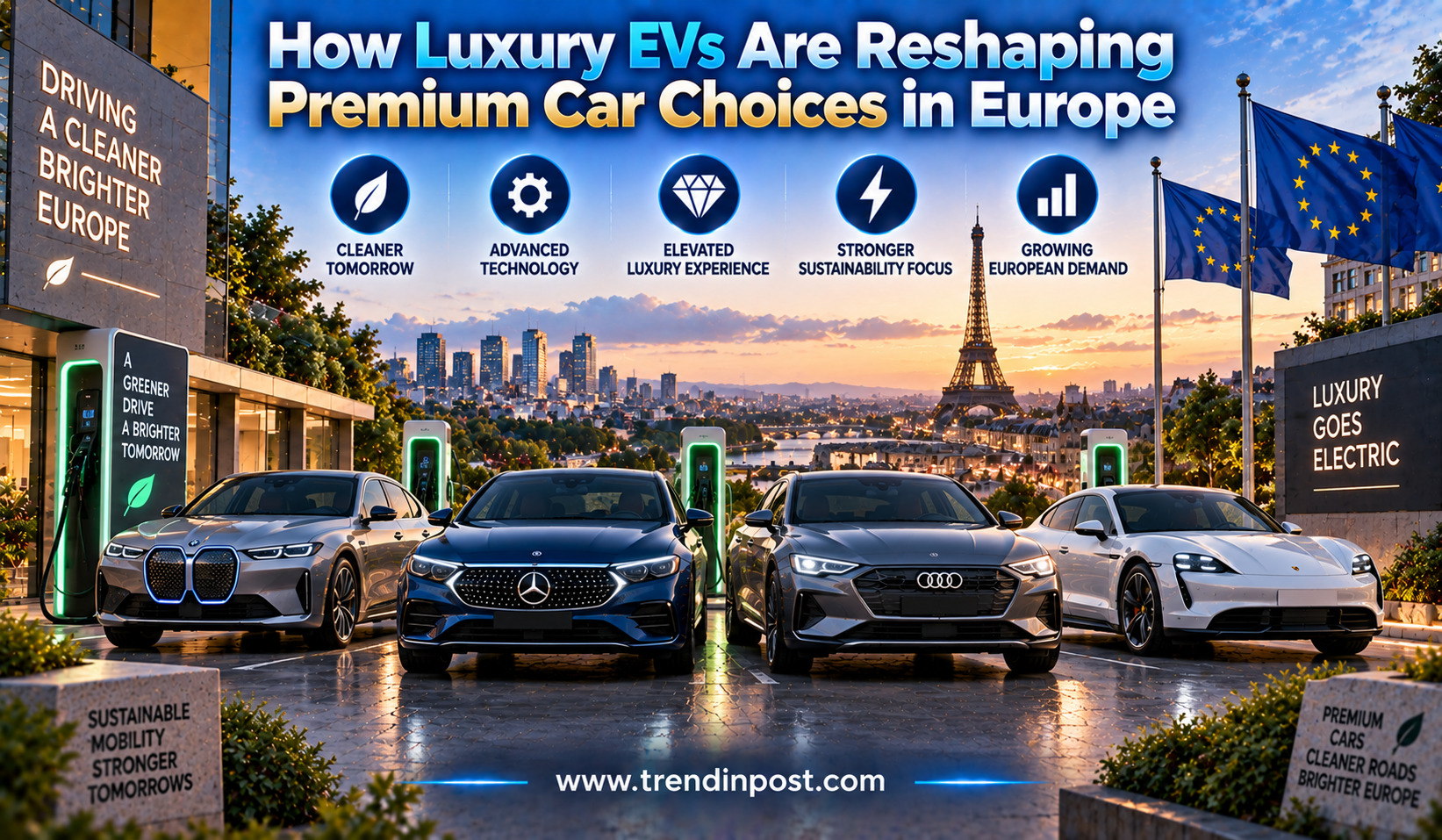
How Luxury EVs Are Reshaping Premium Car Choices in Europe
Luxury cars in Europe are entering a new phase as electric vehicles move from being an alternative powertrain to becoming an increasingly important part of the premium market. Mercedes-Benz, BMW, Audi, Porsche, Volvo, Jaguar and other premium manufacturers are expanding their electric ranges, while newer brands are using EV technology to challenge established names.
The shift is no longer limited to environmentally focused buyers. Premium customers are increasingly considering electric cars for their quiet cabins, rapid acceleration, advanced technology and refined driving experience. As a result, the traditional definition of a luxury car is changing. Instead of focusing primarily on engine size, leather quality and performance, buyers are increasingly looking at software, charging capability, battery range and digital features alongside conventional luxury attributes.
The wider European market shows how quickly this transition is developing. Battery-electric cars accounted for 20.7% of new EU registrations in the first half of 2026, compared with 15.6% during the same period in 2025. Hybrid vehicles remained the largest powertrain category, but petrol and diesel together fell to 29.7% of registrations.
Luxury EVs Are Changing What Premium Means
For decades, premium motoring in Europe was closely associated with powerful petrol and diesel engines. Large executive saloons and SUVs offered smooth performance, long-distance capability and prestige. Electric vehicles are changing the characteristics buyers associate with those qualities.
An electric powertrain delivers power almost immediately, allowing even large luxury cars to provide strong acceleration without relying on a large combustion engine. The absence of traditional engine noise also creates a quieter cabin, which can make an EV particularly attractive to customers who place comfort high on their list.
This has encouraged luxury manufacturers to rethink the entire vehicle rather than simply replacing a petrol engine with an electric motor. Modern premium EVs often combine minimalist interiors, large digital displays, connected services, advanced driver assistance and sophisticated battery-management systems.
The result is a different interpretation of luxury. Smoothness and technology can now be just as important as engine performance.
Premium Electric SUVs Are Becoming More Important
SUVs have already transformed the premium-car market, and electrification is strengthening that trend. Luxury EV SUVs offer manufacturers the opportunity to combine a spacious body, high driving position and premium equipment with an electric powertrain.
Models such as the BMW iX, Mercedes-Benz EQE SUV, Audi Q8 e-tron family, Porsche Macan Electric and Volvo EX90 illustrate the range of approaches manufacturers are taking. Some focus heavily on performance, while others emphasise family practicality, comfort or long-distance capability.
For customers, an electric SUV can be attractive because it does not require them to sacrifice the characteristics they expect from a premium vehicle. Large cabins, high-quality materials and advanced infotainment remain central to the experience.
The growing popularity of this category also means that electric luxury vehicles are no longer restricted to traditional saloon shapes. Buyers can increasingly choose from compact premium crossovers, large family SUVs and high-performance electric models.
Electric Saloons Are Rewriting the Executive-Car Formula
The traditional European executive saloon is also being reshaped by electrification. BMW, Mercedes-Benz and Audi have introduced electric alternatives aimed at customers who previously considered their conventional executive cars.
The electric saloon offers a particularly strong match for the traditional luxury-car formula. Its quiet powertrain supports a relaxed cabin environment, while a large battery can provide the range required for business and motorway journeys.
However, the electric executive segment is becoming more competitive. Established European manufacturers now face competition from Tesla and rapidly expanding Chinese brands. In 2025, Volkswagen overtook Tesla as Europe’s leading EV seller, with Volkswagen Group’s battery-electric sales rising sharply as competition intensified.
This competition matters to premium brands because customers who once had only a handful of luxury EV choices can now compare many more vehicles on range, charging speed, software and price.
Technology Is Becoming Part of the Luxury Experience
One of the biggest changes brought by luxury EVs is the growing importance of software. In a conventional luxury car, premium features were often physical: powered seats, high-end audio systems, climate controls and advanced suspension.
Electric cars add another layer. Software can control battery performance, charging schedules, driving modes, navigation and many elements of the vehicle’s user interface. Over-the-air updates can also allow manufacturers to improve or modify certain functions after a vehicle has been delivered.
This changes the relationship between the buyer and the vehicle. A premium EV is increasingly a connected digital product as well as a physical car.
For European luxury manufacturers, this creates both an opportunity and a challenge. Their established strengths in engineering and interior design remain important, but customers are also judging vehicles based on screen responsiveness, navigation quality, mobile connectivity and the overall digital experience.
Range and Charging Still Influence Premium Choices
Despite the progress made by luxury EVs, range remains an important consideration for European buyers. Premium customers may expect to travel long distances without making frequent stops, particularly in countries where motorway journeys are common.
Battery technology has improved, and newer EVs can offer substantially greater range than earlier generations. Audi’s recently unveiled A2 e-tron, for example, is claimed to achieve up to 646 km of range under its stated test conditions. The company is positioning the model as a highly efficient electric vehicle for the European market, with deliveries expected from December 2026.
Charging infrastructure is also expanding, although availability remains uneven between European countries. By June 2026, public charging capacity across the EU had reached 41.6 GW, while the number of public charging stations had increased 21% year over year. Even so, the infrastructure remains below the level required to meet Europe’s longer-term electrification goals.
For luxury buyers, charging speed can therefore be nearly as important as battery capacity. A vehicle capable of adding significant range during a short motorway stop may be more attractive than one with a slightly larger battery but slower charging.
Luxury EVs Are Increasing the Choice for Buyers
The biggest impact of electrification may be the sheer variety now available to premium customers. Buyers are no longer forced to choose between a small city EV and a conventional luxury saloon. The market now covers a wide range of premium electric vehicles.
| Luxury EV category | Main attraction | Typical buyer priority |
| Premium electric hatchback | Compact size and efficiency | Urban driving and technology |
| Electric executive saloon | Comfort and refinement | Business and long-distance use |
| Luxury electric SUV | Space and road presence | Family practicality |
| Performance EV | Rapid acceleration and handling | Driving performance |
| Ultra-luxury EV | Exclusivity and craftsmanship | Prestige and personalisation |
This wider choice is putting pressure on manufacturers to differentiate their products more clearly. Simply having an electric powertrain is no longer enough.
Chinese EV Brands Are Adding Pressure
European luxury manufacturers are also facing a growing challenge from Chinese electric-car companies. Brands such as BYD, Nio, Xpeng and others are expanding their presence in Europe, bringing strong technology offerings and increasingly competitive products.
This competition is especially relevant to premium manufacturers because Chinese companies have developed considerable expertise in batteries, software and electric powertrains.
European brands still have major advantages in brand recognition, design heritage and established dealer networks. However, luxury customers are increasingly willing to compare vehicles across traditional brand boundaries.
The competitive environment could therefore push European manufacturers to improve efficiency, technology and pricing while protecting the premium qualities that justify higher prices.
Premium Buyers Are Looking Beyond Performance
Luxury-car buyers have traditionally been attracted to horsepower and acceleration, but EVs are changing how performance is evaluated. Almost every modern performance EV can deliver strong acceleration, meaning manufacturers need to differentiate themselves in other areas.
Ride quality, steering response, braking performance, thermal management and long-distance efficiency are becoming more important. A luxury EV needs to perform consistently rather than simply deliver an impressive acceleration figure.
This is particularly important for brands such as Porsche, where driving character forms a major part of the product identity. Porsche reported that fully electric vehicles represented 22.2% of its global deliveries in 2025, alongside 12.1% plug-in hybrids, demonstrating how electrification is becoming part of the performance-luxury market.
Ownership Costs Are Also Influencing Decisions
Running costs are another factor that can influence premium-car buyers. EVs generally have fewer mechanical components than combustion-powered vehicles, which can potentially simplify certain maintenance requirements. However, electricity prices, public charging costs, insurance and depreciation can vary considerably across European markets.
The financial case is particularly important for company-car users. Corporate registrations account for a substantial share of Europe’s new-car market, and tax policies can influence which powertrains businesses and employees choose.
Government incentives also remain important. ACEA has noted that EV adoption is considerably stronger in some higher-income European countries and that demand support measures can have a significant influence on market uptake.
This means the luxury EV market is not developing at exactly the same speed across Europe. Tax rules, charging infrastructure, electricity costs and consumer purchasing power can produce very different outcomes from one country to another.
The Future of Premium Cars Could Be More Electric and More Digital
The European premium-car market is unlikely to become completely electric overnight. Hybrids continue to hold the largest share of new EU registrations, while some customers remain concerned about charging infrastructure, resale values and long-distance convenience.
Nevertheless, the direction of travel is clear. Battery-electric vehicles increased their EU market share from 15.6% in the first half of 2025 to 20.7% in the first half of 2026.
For luxury manufacturers, the transition is therefore about more than replacing engines. It is about redefining what customers should expect from a premium vehicle.
The next generation of luxury cars is likely to combine electric propulsion with advanced software, improved connectivity, sophisticated driver assistance and increasingly personalised interiors. Manufacturers that can bring these technologies together without compromising comfort and quality will have a stronger chance of attracting premium buyers.
Final Thoughts
Luxury EVs are changing the European premium-car market by expanding the definition of what a high-end vehicle can be. Quiet electric power, rapid acceleration and advanced digital systems are now competing with traditional luxury qualities such as craftsmanship, comfort and brand prestige.
The growing range of electric SUVs, executive cars and performance models gives buyers more choice than ever. At the same time, competition from Chinese manufacturers and improvements in charging infrastructure are pushing established European brands to move faster.
The transition is still developing, and hybrids and combustion engines will remain part of the market for years. But the rise of luxury EVs is already influencing purchasing decisions, product development and the meaning of premium motoring across Europe.
Frequently Asked Questions
Are luxury EVs becoming more popular in Europe?
Yes. Battery-electric vehicles represented 20.7% of new EU car registrations in the first half of 2026, up from 15.6% a year earlier. Luxury EVs are benefiting from the broader expansion of electric-car choices.
Why are electric cars attractive to luxury buyers?
Quiet operation, instant torque, smooth acceleration, advanced technology and sophisticated digital features make EVs a natural fit for many premium customers.
Are electric SUVs popular in the luxury market?
Yes. Electric SUVs have become an important part of the premium market because they combine the practicality and road presence buyers expect from SUVs with electric driving.
Is charging still a problem for luxury EV buyers?
Charging infrastructure has improved significantly, but availability remains uneven across Europe. Buyers who regularly travel long distances should consider charging networks and charging speed alongside battery range.
Are Chinese EV brands challenging European luxury manufacturers?
Yes. Chinese manufacturers are expanding their European presence and competing through technology, pricing and electric-car expertise. This is increasing competitive pressure on established European brands.
Related Post
BMW vs Mercedes-Benz: How Their Car Philosophies Differ
BMW and Mercedes-Benz have spent decades competing in the premium car market, but the two…