What Makes a Car Suitable for Large Indian Families?
>> Automobile>> What Makes a Car Suitable for Large Indian Families?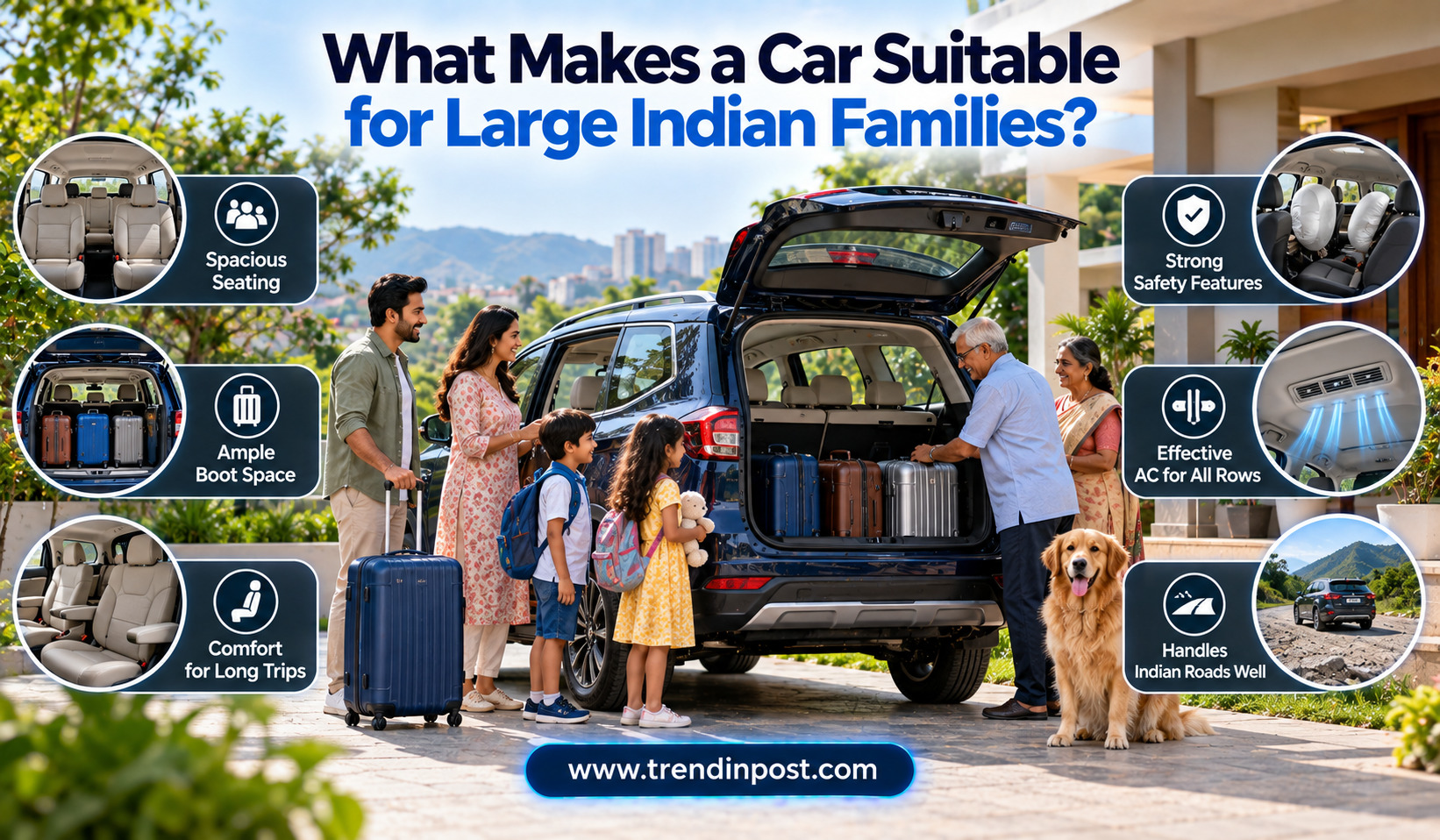
What Makes a Car Suitable for Large Indian Families?
Choosing a car for a large Indian family is very different from choosing one for an individual buyer or a small household. Indian families often travel together for festivals, weddings, holidays, shopping trips and weekend outings, which means a vehicle needs to offer more than just attractive styling or a powerful engine. Space, comfort, safety, practicality and running costs can all play an important role in deciding whether a car is genuinely suitable for a larger family.
The growing popularity of SUVs and MPVs in India reflects this change in buying preferences. Buyers are increasingly looking for vehicles that can accommodate more passengers while still offering modern features and comfortable interiors. However, having three rows of seats alone does not automatically make a vehicle a good family car. The usability of those seats, boot space, access to the third row and overall driving experience matter just as much.
Cabin Space Is the First Priority
For a large family, interior space is perhaps the most important consideration. A vehicle may look large from the outside, but the actual cabin experience depends on how effectively the available space is used.
A family-oriented car should provide enough shoulder room, legroom and headroom for passengers in different seating positions. The second row is particularly important because it is commonly occupied by adults. If the second-row seats are too narrow or uncomfortable, long journeys can quickly become tiring.
The third row also deserves careful attention. Many seven-seater vehicles offer additional seats, but the amount of usable space can vary significantly. Adults may find some third-row seats suitable only for shorter journeys, while children may be more comfortable there. Buyers should therefore physically sit in all three rows before deciding.
Seven Seats Are Not Enough
The popularity of seven-seater SUVs and MPVs has increased because they offer greater passenger capacity than conventional hatchbacks and sedans. But the number of seats should not be the only deciding factor.
A practical family vehicle should make it reasonably easy to enter and exit the third row. Second-row seats that slide or fold can be particularly useful because they create a wider passage for rear passengers. This becomes even more important when older family members or young children regularly travel in the car.
Another important factor is whether the vehicle remains useful when all seats are occupied. Some seven-seaters offer limited luggage space behind the third row. That may be acceptable for short city trips but can become a problem during family holidays when several bags need to be carried.
Boot Space Matters on Family Trips
Large families rarely travel with just a few small bags. Weekend trips, airport transfers and longer holidays can require substantial luggage space. As a result, boot capacity should be considered alongside passenger seating.
A good family car should ideally offer flexible luggage arrangements. Foldable third-row seats can help increase cargo space when fewer passengers are travelling. Split-folding seats are even more useful because they allow families to balance passenger and luggage requirements.
For example, a family may need all seven seats for a local function but only five seats for a holiday. In the second situation, folding the third row can provide considerably more luggage room. This flexibility can make an SUV or MPV much more useful than a vehicle with a fixed seating arrangement.
Comfort Becomes More Important on Long Journeys
Family cars are frequently used for long-distance travel in India. Whether it is a road trip to a hill station, a visit to relatives in another city or a religious journey, passengers can spend several hours inside the vehicle.
Comfort therefore needs to be evaluated beyond the driver’s seat. Well-cushioned seats, adequate legroom, rear air-conditioning and sufficient ventilation can make a major difference during longer journeys.
A comfortable suspension is also important because Indian roads can vary considerably between highways, city streets and rural routes. A vehicle that handles uneven surfaces without excessive movement can provide a more relaxed experience for passengers.
Safety Should Be a Major Buying Factor
When several family members travel together, safety becomes even more important. A large vehicle should not be selected simply because it has more seats or a bigger cabin. Buyers should examine the safety equipment and crash-test performance of the vehicle wherever reliable ratings are available.
Modern family cars can offer a combination of passive and active safety systems. Depending on the model and variant, these may include:
- Multiple airbags
- Electronic Stability Control
- ABS with Electronic Brakeforce Distribution
- Hill-hold assistance
- Parking sensors and rear-view cameras
- ISOFIX child-seat mounts
Higher-end models may also offer advanced driver-assistance systems such as adaptive cruise control, lane-keeping assistance and autonomous emergency braking. However, the availability of these features varies by model and variant.
Safety equipment should be considered as part of the overall package rather than treated as an optional luxury. Families should also check whether important safety features are available on the specific variant they intend to purchase.
Easy Access Makes a Difference
Getting into and out of a vehicle can become surprisingly important when several generations travel together. Young children, senior family members and passengers carrying bags can all benefit from wide doors and a comfortable step-in height.
SUVs offer a commanding driving position, but very tall vehicles may not be equally convenient for every passenger. MPVs often provide a lower floor and sliding doors, depending on the model, making access to the second and third rows easier.
A test drive should therefore include more than checking how the vehicle drives. Every family member who regularly travels in the car should have an opportunity to enter, sit and move between the seating rows.
Engine Performance Should Match the Load
A family car can spend much of its life carrying several passengers. When seven people and luggage are inside, the vehicle can be considerably heavier than when it is occupied by only one or two people.
This makes engine performance an important consideration. A powertrain should provide sufficient performance for city traffic, overtaking and highway driving without requiring excessive effort from the driver.
Automatic transmissions can be particularly convenient for families who spend a lot of time in congested cities. Manual transmissions can still appeal to buyers who prefer greater control or want to keep purchase and maintenance costs within a particular budget.
Fuel efficiency also matters because family vehicles are often used frequently. Buyers should consider the balance between performance, fuel economy and their typical driving conditions rather than focusing only on the engine’s peak power figure.
Technology Should Improve Convenience
Modern family cars increasingly offer technology designed to make everyday travel easier. Large infotainment screens can provide navigation and entertainment, while smartphone connectivity allows passengers to access familiar apps.
Rear passengers can also benefit from dedicated charging ports, rear air vents and practical storage areas. These details may appear small individually, but they become more valuable when several people spend time inside the vehicle.
Some family-oriented models also provide features such as wireless charging, connected-car technology, multiple USB ports, automatic climate control and electrically adjustable seats. However, buyers should focus on features they will actually use rather than selecting a car solely because it has a longer equipment list.
Practical Storage Is Often Overlooked
Families carry more items than individual buyers. Water bottles, bags, toys, electronic devices, food containers and other everyday objects can quickly occupy the cabin.
Well-designed storage spaces can therefore improve the ownership experience. Door pockets, cupholders, centre-console storage and seat-back pockets help passengers keep personal items organised.
This is one area where an interior should be judged during a physical inspection. A specification sheet may mention the number of seats and infotainment features, but it rarely explains how convenient the cabin feels when everyone is carrying personal belongings.
Ground Clearance and Indian Road Conditions
Indian families often travel beyond major cities, where road conditions can vary considerably. Potholes, uneven surfaces, steep ramps and poorly maintained roads can make ground clearance an important consideration.
SUVs generally offer higher ground clearance than conventional sedans, which can provide additional confidence on rougher roads. However, ground clearance should not be considered the only measure of a vehicle’s ability to handle difficult roads. Suspension tuning, tyre size and overall vehicle dynamics also influence the driving experience.
For buyers who frequently travel between cities or visit rural and hilly areas, these characteristics can become more important than purely cosmetic SUV styling.
Running Costs Should Not Be Ignored
Buying a large car is only the beginning of the ownership cost. Fuel, insurance, servicing, tyres and unexpected repairs can all affect the family budget.
A larger SUV may provide more space and road presence but could also consume more fuel than a smaller vehicle. Similarly, premium features and larger tyres may increase replacement or maintenance expenses.
Before purchasing, families should consider their annual driving distance and how frequently the vehicle will be used. A fuel-efficient MPV may make more sense for one household, while a larger SUV may be preferable for another that regularly travels long distances.
SUV vs MPV for Large Families
Both SUVs and MPVs can work well for larger Indian families, but their strengths are slightly different.
| Requirement | SUV | MPV |
| Road presence | Generally strong | Usually more understated |
| Third-row access | Depends on model | Often designed with family access in mind |
| Ground clearance | Usually higher | Varies by model |
| Passenger comfort | Good in larger models | Often a major focus |
| Luggage flexibility | Depends on seating layout | Often strong |
| City manoeuvrability | Varies by size | Generally practical |
| Long-distance use | Strong in suitable models | Often very family-oriented |
There is no universal winner. The better choice depends on the family’s passenger count, driving environment, budget and preferred vehicle characteristics.
What Families Should Check Before Buying
A test drive should be treated as a family evaluation rather than just a driver’s evaluation. Buyers should check whether all regular passengers can sit comfortably, whether the third row is practical and whether luggage can be accommodated with the expected number of passengers.
It is also worth checking child-seat compatibility, rear-seat ventilation, parking visibility and the ease of folding or accessing different seating rows. These details can have a bigger impact on everyday ownership than some headline features.
A short checklist can help buyers remember the most important areas:
- Test all three seating rows.
- Check luggage capacity with the expected number of passengers.
- Compare safety equipment on the exact variant.
- Evaluate fuel economy and maintenance costs.
- Test the vehicle in city traffic and, if possible, on uneven roads.
Final Thoughts
The ideal car for a large Indian family is not necessarily the biggest or most expensive vehicle available. Instead, it should offer a sensible combination of passenger space, comfort, safety, practicality and manageable ownership costs.
Seven seats can be useful, but the quality and usability of those seats matter more than the number printed in the brochure. Similarly, a large touchscreen may look impressive, but features such as rear air-conditioning, easy third-row access, flexible luggage space and strong safety equipment can have a much greater effect on family travel.
For buyers considering an SUV or MPV, the best approach is to think about how the vehicle will be used throughout the year. A car that comfortably handles school runs, city traffic, family functions and long road trips is likely to deliver greater value than one chosen purely for its size or appearance.
FAQs
1. What is the most important feature in a car for a large family?
Interior space is one of the most important factors. However, passenger comfort, third-row usability, safety and luggage capacity should also be considered.
2. Is a seven-seater SUV suitable for a large Indian family?
It can be, especially if the third row is comfortable and the vehicle provides enough luggage flexibility. Buyers should test all three rows before purchasing.
3. Which is better for a large family, an SUV or an MPV?
Both can be suitable. SUVs generally offer higher ground clearance and strong road presence, while MPVs often focus more heavily on passenger access, seating flexibility and family practicality.
4. How important is boot space in a family car?
Boot space is very important for families travelling with luggage. Buyers should check available cargo room when all seats are occupied rather than relying only on the manufacturer’s maximum boot figure.
5. Should families prioritise safety features over luxury features?
Yes. Safety equipment should be a primary consideration. Features such as airbags, ESC, ABS and reliable crash-test performance are generally more important than cosmetic or entertainment features.
Related Post

Practical Car Features You May Miss During a Test Drive
Buying a new car is often an exciting experience. During a test drive, most buyers…