Cartier vs Rolex: Which Brand Fits Your Style?
>> LifeStyle>> Cartier vs Rolex: Which Brand Fits Your Style?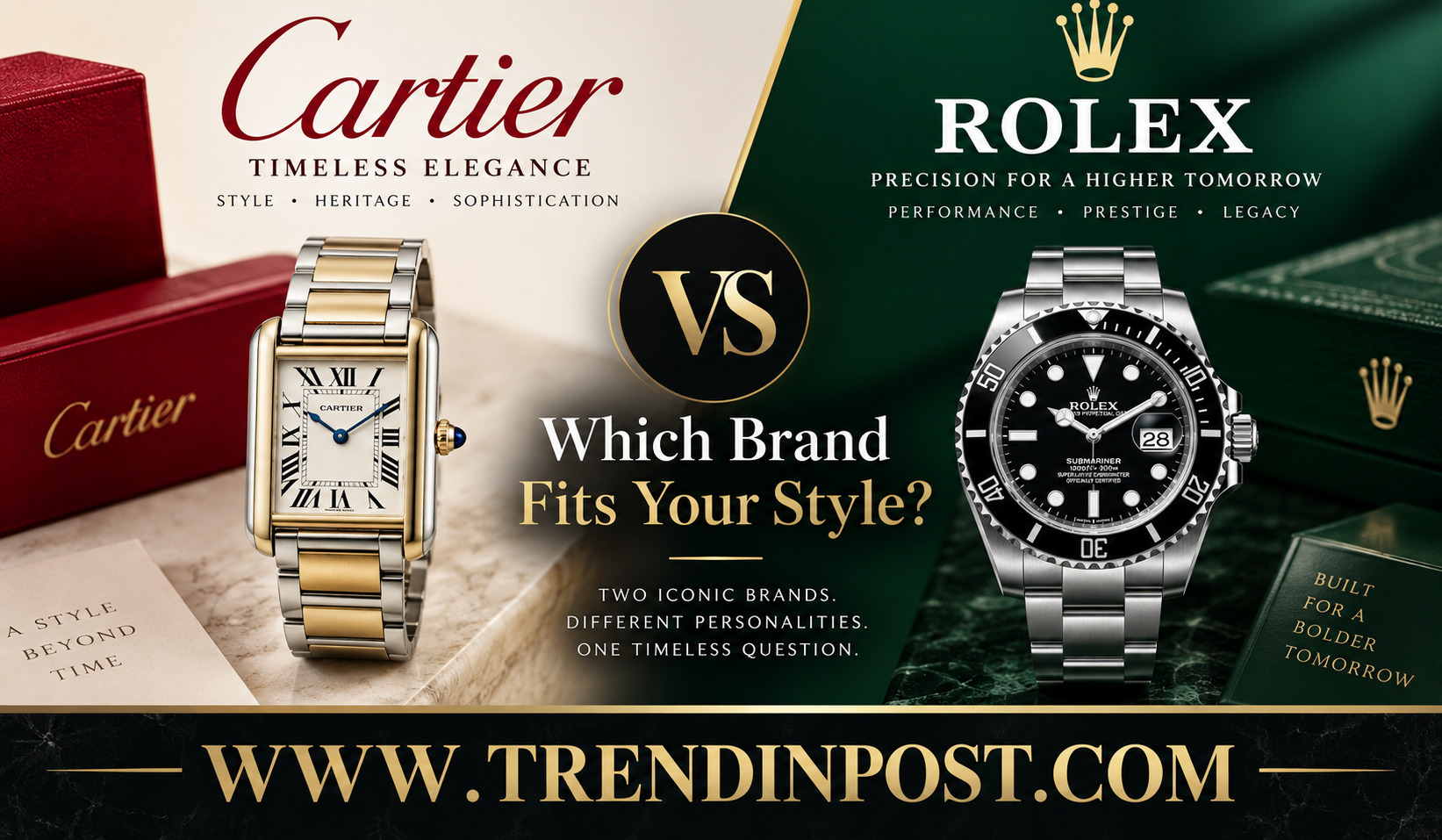
Cartier vs Rolex: Which Brand Fits Your Style?
Introduction
Rolex built a tool watch empire, while Cartier built the wristwatch itself back in 1904 with the Santos. Both brands sit near the top of the luxury watch world, but they reach that spot from opposite directions. This guide compares Cartier vs Rolex across design, movements, pricing, and availability, so you can see which one actually fits how you want to wear a watch.
Where Each Brand Came From
Cartier started in 1847 as a Parisian jeweler, earning the nickname jeweler of kings long before it built its first wristwatch. The Cartier Santos, created in 1904 for aviator Alberto Santos-Dumont, is often credited as one of the earliest modern wristwatches, predating several key Rolex innovations by decades.
Rolex was founded in 1905 and built its name around precision and durability, creating what the industry calls tool watches, designed to survive extreme conditions like deep diving or mountaineering.
That gap in origin still defines both brands. Cartier thinks like a jewelry house first, while Rolex thinks like an engineering company first.
Design Philosophy and Case Shapes
Cartier’s jewelry background shows in its range of case shapes, running from the rectangular Tank to the curved Baignoire and the octagonal Santos.
Rolex, by comparison, keeps a narrower design language centered on round cases across most of its lineup. Case sizes for Rolex typically run from about 31 mm to 42 mm, while Cartier spans a wider range, from small 28 mm women’s pieces up to oversized 44 mm men’s models.
- Cartier fits a broader range of formal and casual looks due to its shape variety.
- Rolex leans toward sport and tool aesthetics even in its dressier lines like the Cellini.
- Cartier watches often carry the brand’s signature blue sapphire cabochon crown.
- Rolex cases favor the durable Oyster case design across most sport models.
Movements and Build Quality
Rolex builds its movements entirely in house, and every mechanical model carries COSC chronometer certification, targeting accuracy within a tight daily range.
Cartier uses a mix of approaches. Its higher end pieces run in house calibers like the 1847 MC, while some entry level models use modified movements sourced from established Swiss suppliers. Cartier’s finishing on higher tier movements is often praised for its detail, even when the base caliber is not fully in house.
| Factor | Rolex | Cartier |
| Founded | 1905 | 1847 |
| Movement approach | Fully in house, COSC certified | Mix of in house and modified movements |
| Design range | Mostly round, tool watch focused | Wide range of shapes, jewelry influenced |
| Typical entry price | $5,700 and up | Under $3,000 for entry models |
| Availability | Waitlists common for popular models | Generally available at retail |
Price Ranges Compared
Cartier is generally the more affordable brand to enter. Some Cartier watches are available at full retail price for under $3,000, while Rolex’s cheapest current models list starting around $5,700.
At the high end, both brands climb into precious metal and complicated territory, though Rolex’s sport models often carry stronger secondary market premiums than Cartier pieces at similar price points.
Availability and Buying Experience
Buying a Cartier watch is usually simple. Most models sit in stock at boutiques and authorized retailers without a long wait.
Rolex is a different experience for popular steel sports models like the Submariner or Daytona, where waitlists at authorized dealers can run months or longer. This scarcity feeds a strong gray market, where buyers pay a premium to skip the wait.
Buyers who want to walk in and walk out with a specific watch often find Cartier the easier purchase.
Matching the Brand to Your Style
Someone drawn to bold, sporty designs and strong resale value usually leans toward Rolex. Someone drawn to varied case shapes, jewelry inspired detail, and easier retail access usually leans toward Cartier.
Neither choice is wrong, since both brands carry real heritage and quality. The better fit depends on whether you want a tool watch with broad recognition or a design forward piece with more variety in shape and style.
Key Takeaways
- Origin: Cartier began as a jeweler in 1847, while Rolex began as a watch specialist in 1905.
- Design: Cartier offers far more case shapes, while Rolex stays mostly round and tool focused.
- Movements: Rolex is fully in house and COSC certified, while Cartier mixes in house and modified calibers.
- Price: Cartier generally starts lower than Rolex at retail.
- Availability: Cartier is easier to buy at retail, while popular Rolex models often require a wait.
FAQs
Is Cartier or Rolex more affordable to buy new?
Cartier generally offers lower starting prices than Rolex across comparable tiers.
Does Cartier make its own movements?
Cartier makes some in house movements like the 1847 MC, alongside modified movements from established suppliers in other models.
Why do popular Rolex models have waitlists?
Demand for certain steel sports models outpaces what Rolex produces, which creates waitlists at authorized dealers.
Which brand offers more case shape variety?
Cartier offers far more shapes, including rectangular, curved, and octagonal cases, compared to Rolex’s mostly round lineup.
Can Cartier watches hold value like Rolex?
Some Cartier models hold value well, though Rolex generally offers stronger and more consistent resale demand overall.
Conclusion
Cartier vs Rolex ultimately comes down to design philosophy as much as price or movement specs. Rolex offers engineering focused tool watches with strong resale demand, while Cartier offers jewelry inspired design with easier retail access and a lower entry price. Think about whether you want a watch that blends in with tradition or one that stands out with shape and style, and the right brand becomes clear.
Related Post

How to Manage Money During a Career Break
Taking a career break can be an exciting opportunity to rest, travel, learn new skills,…